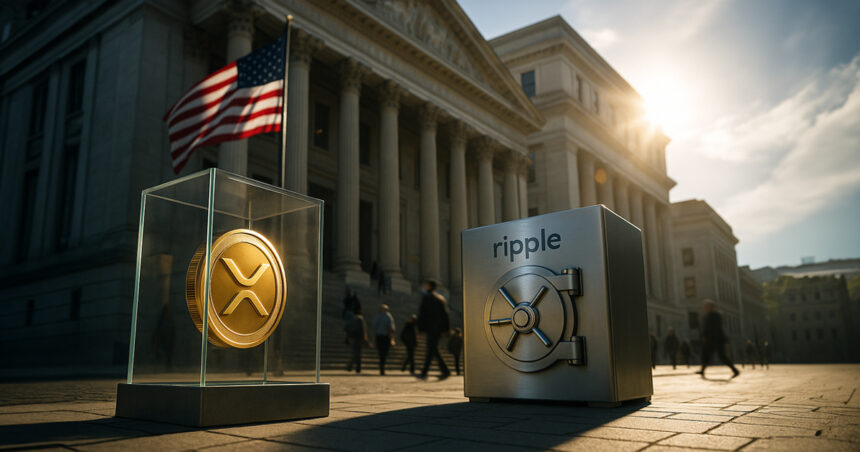
For years, Ripple has been known primarily for its legal disputes and its cryptocurrency, XRP, which embodied the friction between the crypto world and traditional finance. However, following a tumultuous period of courtroom battles, the company has shifted its focus and ambitions, establishing a comprehensive institutional financial platform that resembles a modern investment bank, although it has yet to secure a formal bank charter.
The recent launch of Ripple Prime, a digital-asset brokerage, alongside the integration of Ripple Payments and Ripple Custody, marks a significant positioning for Ripple in the expanding landscape of digital finance. These developments create a cohesive ecosystem designed to settle, secure, and transfer digital currency globally, all while utilizing Ripple’s proprietary technology. Central to this ecosystem are XRP and RLUSD, its regulated stablecoin pegged to the dollar.
With clarification on its legal standing following a challenging relationship with the U.S. Securities and Exchange Commission (SEC), Ripple has focused on transitioning from a blockchain entity to a recognized financial infrastructure provider. This strategy accelerated with a series of 2025 acquisitions—such as prime brokerage Hidden Road, custody firm Palisade, treasury-management platform GTreasury, and stablecoin payments firm Rail—laying the groundwork for an extensive enterprise covering trading, custody, payments, and liquidity management.
Ripple Prime serves as the trading interface, while Ripple Custody employs multi-party computation and zero-trust architecture to safeguard institutional assets. Ripple Payments allows for real-time transactions across various blockchains and fiat currencies. Meanwhile, RLUSD integrates these functionalities, creating a seamless medium for value exchange within the ecosystem.
Ripple’s strategy is particularly distinct due to the level of integration achieved within its framework. The company’s liquidity model is designed to be circular: institutional clients utilize Ripple Prime for trading, store assets in Ripple Custody, and conduct payments via Ripple Payments, all intertwined through the use of XRP and RLUSD. This closed liquidity system not only minimizes friction and expedites transactions but creates an environment where value remains within Ripple’s ecosystem, akin to the “walled garden” model popularized by Apple.
Evidence of Ripple’s successful strategy is already apparent. The trading volume of XRP has surged to multi-year highs, and the supply of RLUSD exceeded $1 billion in November, reflecting a month-on-month increase of over 30%. A significant portion of this demand stems from institutional players utilizing RLUSD to hedge investments and fulfill cross-border transactions.
Ripple’s commitment to regulatory compliance is further bolstered by its formal application for a national bank charter from the U.S. Office of the Comptroller of the Currency (OCC) and efforts to secure a Federal Reserve Master Account through its subsidiary, Standard Custody. If successful, these endeavors would allow for RLUSD reserves to be held directly with the Federal Reserve, minimizing the risk associated with intermediaries and enhancing transparency—a key concern for institutional investors.
The overarching ambition of Ripple is to replicate traditional banking capabilities using cryptocurrency infrastructure. While traditional banks rely on outdated systems like SWIFT, Ripple proposes near-instant settlements via its blockchain technology. It integrates custody and settlement into its protocol rather than depending on external custodians and clearinghouses. Additionally, RLUSD serves a similar function to credit issuance and liquidity management through its backing by short-term Treasuries and cash instead of loans.
Ripple executives view this evolution not as a challenge to traditional finance but rather as an opportunity for its modernization. CEO Brad Garlinghouse has emphasized Ripple’s commitment to transforming the financial landscape by leveraging their unique strengths and technological framework.
With these advancements, Ripple stands at the intersection of regulated finance and decentralized settlement, facilitating the movement of tokenized real-world assets while enhancing operational efficiencies. The company’s acquisition of GTreasury opens avenues to connect with a vast array of corporate treasurers managing trillions in assets, presenting RLUSD with the potential to evolve into a substantial treasury instrument for payments and liquidity management.
Each component of Ripple’s infrastructure mutually reinforces one another: custody safeguards the assets, Prime facilitates trading, Payments ensures capital flow, and RLUSD serves as the foundational stablecoin. As Ripple approaches the potential approval of its OCC charter and a Federal Reserve account, it nears the milestone of becoming the first blockchain-native institution operating within established U.S. financial laws.
Ripple’s President, Monica Long, articulated the company’s mission to modernize cross-border value transfers by dismantling obsolete systems entrenched in fragmented payment structures. Ripple’s objective extends beyond the crypto realm, aiming to provide its advantages to the larger financial ecosystem and remove long-standing barriers.
As Ripple transitions from a company that once battled for XRP’s legitimacy to one that shapes the infrastructure of regulated crypto finance, questions arise about whether it will compete with traditional banking or integrate with it. Regardless, it is becoming increasingly evident that the future of banking may not be confined to traditional institutions.