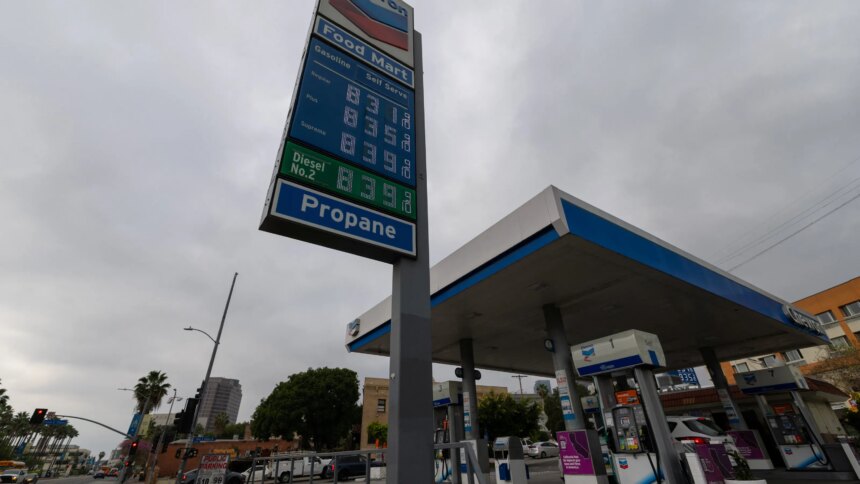
Rising gasoline prices and a fluctuating stock market are raising concerns that the ongoing U.S.-Israeli military operations against Iran could significantly impact American consumers across all economic sectors. Analysts had anticipated that the economic recovery in 2026 would be bolstered by increased income tax refunds, low unemployment rates, and growing asset values. As the year commenced, there was optimism that both wealthier households and lower-income workers would sustain or even increase their spending due to favorable economic factors.
However, recent developments have introduced a new set of pressures. As of Tuesday morning, average national gasoline prices surged to over $3.50 per gallon, marking a 17% increase from the pre-conflict average of approximately $3. This rise in fuel costs has been felt nationwide, with the only exception being Kansas, where prices lingered around $2.96. The volatility of oil markets, exacerbated by disruptions in the Strait of Hormuz, raises the prospect of gasoline prices reaching $4 if these tensions continue.
The stock market has also experienced significant fluctuations. On Monday, President Donald Trump hinted at a potential swift resolution to the conflict, momentarily boosting stock prices. However, his subsequent comments suggested a possibility of a prolonged engagement, fueling uncertainty about future impacts on global supply chains, commodity markets, and corporate earnings. Major U.S. stock indices remained largely unchanged as trading began on Tuesday.
For lower-income families, the surge in gasoline prices could lead to reduced spending in other areas, thereby impacting businesses and potentially prompting job cuts and lower investments. Economists warn that sustained high oil prices could transition from benefiting certain companies to becoming a drag on overall economic growth. Luke Tilley, chief economist at Wilmington Trust, emphasized that prolonged prices in the $85 to $100 per barrel range would heighten recession risks, particularly as the labor market faces ongoing challenges.
Brent crude prices recently soared above $116 per barrel before falling below $90, only to rise again on Tuesday. Amid these fluctuations, U.S. Defense Secretary Pete Hegseth indicated that intense military action against Iran was expected, contrasting with discussions about targeting Iran’s mining capabilities in the Strait of Hormuz, a critical oil shipping route.
The escalating situation presents a challenge for policymakers at the U.S. central bank. Initially, officials anticipated a strong economy with a balanced risk profile, facing both slightly elevated inflation and stable unemployment around 4.3%. However, recent job losses and the uncertainty created by geopolitical conflicts now threaten this outlook. While inflation pressures are expected to ease, higher oil prices could exacerbate costs for shipping and heating, potentially influencing overall inflation expectations.
Despite investors speculating on potential interest rate cuts later in the year, the uncertainty stemming from military actions has caused a reevaluation of timelines. The Federal Reserve is scheduled to meet next week to discuss maintaining the current policy rate range of 3.5% to 3.75%.
Vincent Reinhart, chief economist at BNY Investments, cautioned against drawing premature conclusions regarding the conflict’s economic impact. He noted that while the U.S. remains a net energy producer, which could mean more income and job opportunities for energy firms, persistent high prices could still undermine consumer spending and economic growth.
Ultimately, according to Reinhart, significant alterations to the U.S. economy would only occur if oil prices remained elevated long enough to shift consumer behavior dramatically. He concluded that current price movements have not yet reached a level that would fundamentally alter economic trajectories.