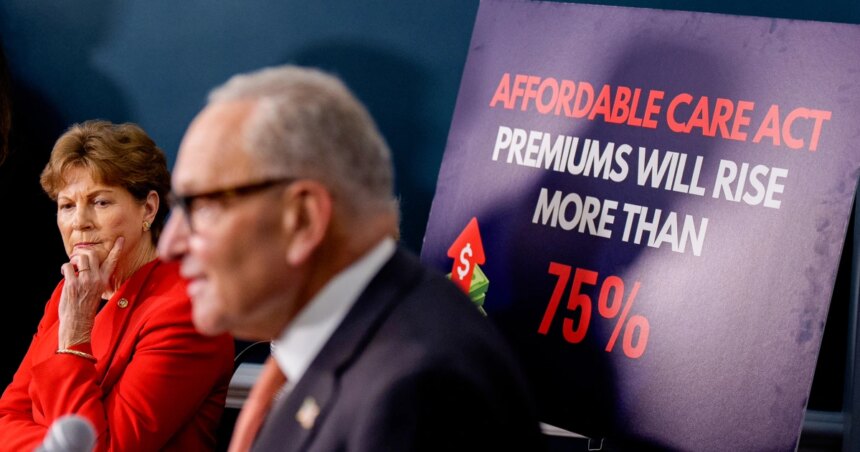
Ginny Murray and her husband, Chaz, find themselves in a precarious situation regarding their health insurance options. As the new year approaches, they anticipate a steep rise in premiums, potentially making their coverage unaffordable. Currently, their monthly premium stands at approximately $1,500, which is mitigated to around $450 due to subsidies provided under the Affordable Care Act (ACA). However, with a recent 26% rate increase approved for their insurer, their premium could surge by at least $400 next year, and possibly much higher if the subsidies expire.
The Murrays plan to drop their coverage entirely, opting to save the premiums they can no longer afford while hoping that their savings will be sufficient should they confront unexpected health challenges. This choice reflects a broader trend among Americans as enhanced ACA subsidies are set to lapse at the end of the year, with projections indicating that nearly 4 million people might forego their health insurance in 2024.
Art Caplan, head of the medical ethics division at NYU Grossman School of Medicine, notes that the anticipated hike in premiums will be the most significant since the ACA’s inception in 2010. In preparation for open enrollment next month, many are now grappling with these new financial realities.
Historically, decisions to go uninsured are not new. Before the ACA passed in 2010, millions faced dire circumstances as a result of lacking coverage—often leading to financial ruin. Since the ACA’s implementation, the rate of uninsured Americans has plummeted—from about 16%, or 48 million individuals, to just 7.7%, according to the Center on Budget and Policy Priorities. As a consequence of the enhanced subsidies, enrollment in ACA plans has also surged, reaching a record 24.3 million in 2025.
Dr. Adam Gaffney, a critical care physician at Harvard Medical School, underscores the impracticality of relying solely on savings to cover medical emergencies. “Unless you are extraordinarily rich, it is effectively not possible to save enough money to cover the costs of a serious illness or major trauma,” he said, emphasizing that for the uninsured, overwhelming medical debt can be just one incident away.
JoAnn Volk, co-director of Georgetown University’s Center on Health Insurance Reforms, points out that many Americans lack a substantial financial safety net. According to the Federal Reserve, about 37% of adults would struggle to cover a $400 emergency expense. Even those with emergency funds often discover that the amount they have saved pales in comparison to medical expenses.
For D’nelle Dowis, a Denver resident, the decision to drop ACA coverage stems from personal experiences with unexpected medical costs. She recalled how her father’s appendectomy in the 1990s vastly impacted her family’s finances. Now, she and her husband, both healthy and in their 40s, plan to redirect their health insurance premiums into a high-yield savings account, with the monthly premium expected to rise from $600 to $1,300. This decision could lead to cutting back on other necessities, including care for their aging dogs.
In New York City, freelance photographer Claire Esparros is grappling with a similar predicament. Despite primarily using her ACA coverage for routine care, the upcoming tripling of her premium—from about $300 to $900—has prompted her to reconsider her options. She describes her current insurance as difficult to justify and is exploring alternative models, such as health care co-ops that pool funds among members.
Caplan highlights that these community-based self-insurance plans, while potentially offering lower costs for healthy individuals, lack the regulatory protections of the ACA. As individuals like Esparros weigh their options, the situation underscores a rapidly evolving landscape for health insurance in America, with many left questioning whether they can afford coverage at all in the coming year.