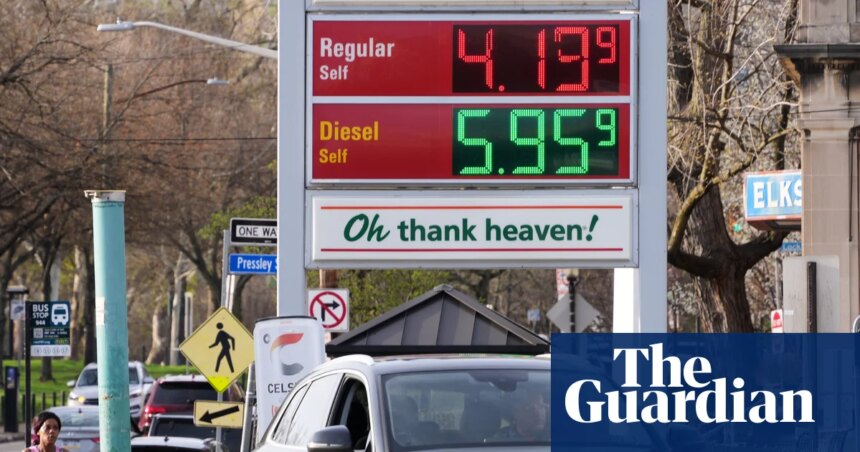
As gasoline and airline ticket prices surge, experts warn that the ongoing conflict in Iran is poised to further inflate costs across various sectors of the economy. Christopher Tang, a professor at the UCLA Anderson School of Management, notes a significant change in economic conditions, stating, “The good old days are gone.” He emphasizes that rising gasoline prices are merely one aspect of a broader trend, predicting a general increase in costs for consumers.
Since the war began at the end of February, crude oil prices have steadily climbed, crossing the $110 per barrel mark this week. The rise in fuel prices is partially attributed to Iran’s control over the Strait of Hormuz, a critical maritime route through which approximately 20% of the world’s oil flows. This strategic chokepoint is now subject to increased tensions and potential blockages due to the conflict.
In a recent address, President Donald Trump asserted that the United States is not reliant on oil from the Middle East. “We’re now totally independent of the Middle East,” he said, while reaffirming America’s ability to assist in the region despite not needing its oil. However, this perspective is contested by Samantha Gross, director of the energy and security initiative at the Brookings Institution. She explains that oil operates as an internationally traded commodity, hence even the U.S., as a leading oil and gas producer, is subject to global market prices. “We’re going to pay the same high prices that the global market is paying,” Gross stated.
Iran’s interference with oil shipments in the Strait of Hormuz comes in the form of blockages or imposing hefty tolls, compelling tankers to choose longer routes or pay high fees, consequently raising logistics costs. This surge in operational expenses has already impacted major retailers; for instance, Amazon announced a 3.5% surcharge for third-party sellers, effective later this month. Additionally, shipping giants like UPS and FedEx have raised their rates and introduced fuel surcharges exceeding 25%, while the U.S. Postal Service plans to implement an 8% surcharge from late April.
Experts express concerns that the current escalation in oil prices will be hard to reverse. David Bieri, an economist at Virginia Tech, points out that although countries have temporarily drawn from their strategic oil reserves, those supplies will eventually need replenishing at the current high prices. He warns, “As these inventories have been depleted, they will need to be filled up again with actually high-priced oil.”
Beyond transportation, the ramifications of rising oil prices will extend to numerous everyday products. Oil’s role in the production of chemicals used in pharmaceuticals and fertilizers means that higher energy costs will inevitably elevate the prices of essential goods, including prescription medications and groceries. Cornel University’s Christopher Wolf explains that the increasing cost of diesel—used both for transportation and as a farm fertilizer—is likely to affect the agricultural sector substantially.
While price adjustments in grocery stores may lag behind rising costs, some retailers may proactively increase prices. “A lot of the retailers and processors have a rational expectations approach,” Wolf noted, suggesting they may make gradual price increases to mitigate the shock to consumers.
The Independent Grocers Alliance recently cautioned that a 10-15% increase in fuel prices could lead to a 2-4% rise in food prices. They anticipate that the full effects of rising logistics costs will become particularly evident by mid-summer.
Trump also indicated an expectation for a swift withdrawal of U.S. troops from Iran, potentially within two to three weeks. However, experts remain skeptical that even a quick resolution to the conflict would alleviate price pressures. Ravi Ramamurti, a professor of international business strategy, described the Strait of Hormuz as a longstanding vulnerability in the oil supply chain. The current situation indicates that concerns over political risk in pricing will linger, with ongoing uncertainties about future flare-ups in the region.
Tang summarized the prevailing sentiment: “When the prices go up, they rarely come back down,” suggesting consumers may need to prepare for a sustained period of elevated prices across the board.