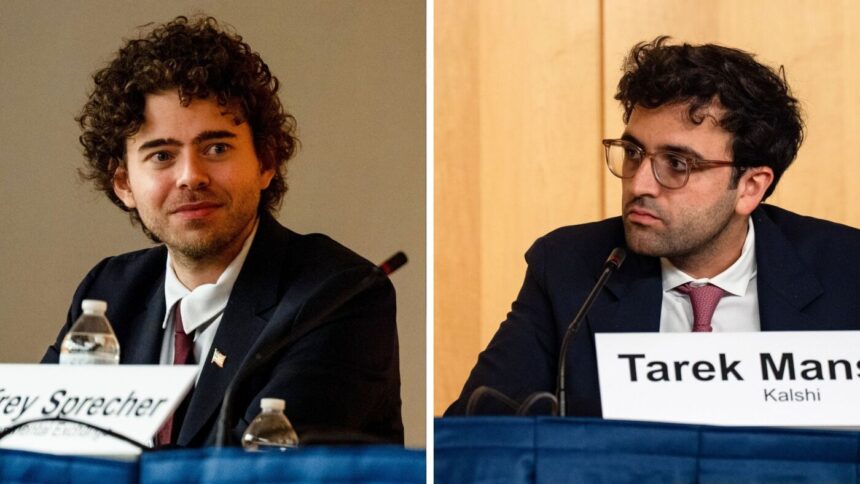
The prediction market industry is witnessing an intense rivalry between two of its most prominent players: Kalshi and Polymarket, both helmed by ambitious young CEOs who are not shying away from public feuds. At the forefront is Kalshi CEO Tarek Mansour, who is known for his disdain for mentioning Polymarket directly, referring to it only as an “unregulated, offshore prediction market.” Mansour’s strategy emphasizes a clear distinction between Kalshi—regulated and compliant with U.S. laws—and Polymarket, which has garnered scrutiny for its approach.
This rivalry reached new heights following an FBI raid on Polymarket CEO Shayne Coplan’s residence in late 2024. The incident sparked a flurry of memes and mockery from Kalshi’s employees as they rallied alongside online influencers to take jabs at their competitor. Mansour likened his competition with Coplan to the storied NFL rivalry between Tom Brady and Eli Manning, suggesting that such fierce competition could steer them both toward greater success.
While Mansour displays a combative public persona, Coplan reportedly keeps his frustrations to a close-knit group. This rivalry has even caught the attention of regulatory bodies: both companies have pending trademark applications claiming to be “the world’s largest prediction market.” Despite Kalshi leading in trading volume, Polymarket has historically asserted its status as the largest.
As the prediction market industry continues to grow rapidly, with billions exchanged weekly on various topics—from entertainment to geopolitics—the battle between these two companies could shape its future trajectory. Industry observers note that the distinct regulatory approaches of each firm are amplifying their antagonism. While Kalshi is positioning itself as a compliant entity under the Commodity Futures Trading Commission (CFTC), Polymarket follows a more aggressive, less restrained path.
Dustin Gouker, a consultant and writer specializing in prediction markets, pointed out that Kalshi is eager to differentiate itself from Polymarket. He noted that this desire to establish a clear identity is further fueled by Mansour’s relentless push for growth and user acquisition, a mindset that has purportedly intensified due to Polymarket’s mounting popularity.
The ongoing feud is juxtaposed against a burgeoning prediction market landscape, as various sectors, including major financial players like Coinbase and Robinhood, eye opportunities to enter this space. Yet, despite competitors emerging, Kalshi and Polymarket remain the dominant forces.
Mansour, a graduate from the Massachusetts Institute of Technology with experience at high-profile Wall Street firms, advocates for a regulatory-friendly approach. He’s publicly expressed his commitment to working within the governmental framework to develop Kalshi responsibly. In contrast, Coplan, a former New York University dropout who took an entrepreneurial route through cryptocurrency trading, adopts a more cavalier stance, prioritizing rapid expansion, even in light of federal scrutiny.
Polymarket’s market offerings have pushed ethical boundaries, including controversial topics which have triggered backlash. Critics in government and media have raised concerns over the implications of betting on high-stakes events, showcasing the inherent risks in unregulated environments.
Meanwhile, as both companies vie for user attention and markets, they’re also competing for strategic partnerships. Kalshi recently announced a collaboration with CNN, while Polymarket unveiled an alliance with Dow Jones. These maneuvers highlight the ongoing tug-of-war for legitimacy and visibility in the eyes of both the public and regulatory bodies.
One of the most indicative moves in the rivalry was Kalshi’s formation of the Coalition for Prediction Markets, aimed at promoting a unified voice for the industry. This initiative is focused on developing clear guidelines and trust in prediction markets, notably without Polymarket as a participant—a conspicuous absence that suggests the deepening divide.
As both companies continue to innovate and confront each other, the future of prediction markets hangs in the balance, relying on the decisions and strategies of these two billionaire executives and their respective firms.