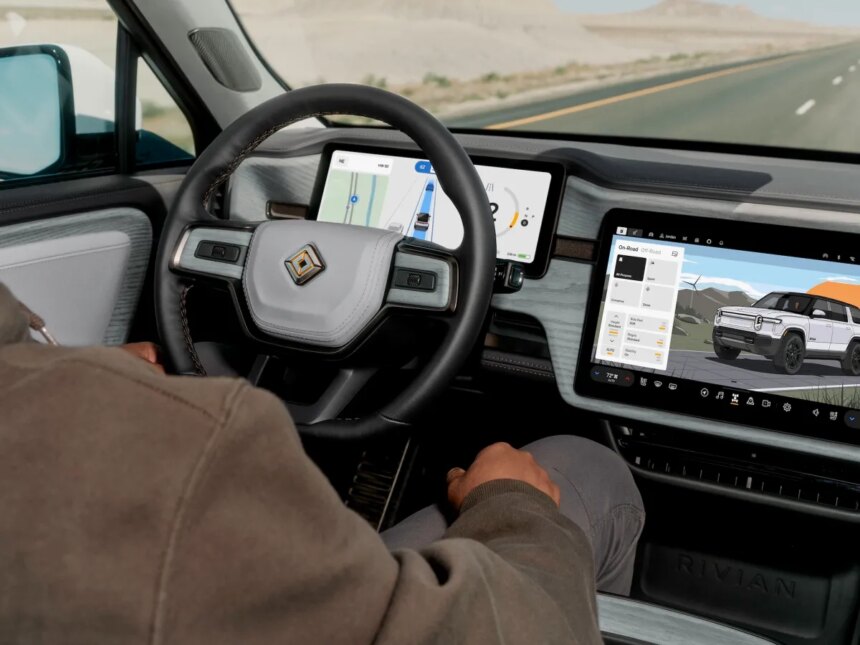
Rivian has outlined a bold vision for the future of its electric vehicles (EVs), focusing on increasing autonomy, during its inaugural “Autonomy & AI Day” event in Palo Alto, California. CEO RJ Scaringe revealed plans to integrate advanced hardware, such as lidar technology and custom silicon, to enhance the self-driving capabilities of its vehicles. This move aligns Rivian with industry leaders like Tesla, Ford, and General Motors, as the company aims for a competitive edge in the evolving market of automated driving.
The company announced the expansion of its hands-free driver-assistance software, expected to cover over 3.5 million miles of road across the United States and Canada. This upgrade, dubbed “Universal Hands-Free,” will launch in early 2026 and will enable drivers to transition from highways to surface streets where clear road markings are present. The system will be available for Rivian’s second-generation R1 trucks and SUVs, for a one-time fee of $2,500 or a monthly subscription of $49.99.
Scaringe explained the key feature, stating, “What that means is you can get into the vehicle at your house, plug in the address to where you’re going, and the vehicle will completely drive you there.” This technology aims to free drivers from the task of driving, allowing them to engage in other activities while on the road.
Rivian’s ambitions don’t stop at driver assistance. The company aims to enhance its technology to reach what it describes as “personal L4” autonomy, a classification from the Society of Automotive Engineers indicating vehicles can operate without human intervention in specific conditions. Scaringe suggested that Rivian may eventually compete in the ride-hail market, following the initial focus on personally owned vehicles, which currently represent most driving miles in the U.S.
To achieve these goals, Rivian is developing a sophisticated driving model that departs from a rules-based framework, exemplified by Tesla. The company showcased its advanced custom 5nm processor, developed in collaboration with Arm and TSMC. This new processor will be the brain behind Rivian’s third-generation autonomy computer, ACM3, which is capable of processing an impressive 5 billion pixels per second. This technology is set to debut in the mass-market R2 SUV expected to launch in late 2026.
The ACM3 will be paired with a lidar sensor positioned at the top of the windshield, set to deliver enhanced three-dimensional spatial data and redundant sensing capabilities. According to senior vice president of electrical hardware Vidya Rajagopalan, this combination is projected to offer the most powerful sensor setup in consumer vehicles in North America at the time of its launch.
Although the R2 will start shipping in the first half of 2026 without these advanced features, Rivian has committed to continuously improving the autonomy capabilities of its R1 and future R2 vehicles. Scaringe emphasized that the integration of new hardware will significantly elevate the autonomy potential of their existing models.
James Philbin, vice president of autonomy and AI, underscored the importance of lidar, stating, “Adding lidar creates the ultimate sensing combination. It gives the most comprehensive 3D model of the space the vehicle is traveling through.” The ultimate goal is not merely to achieve human-like driving abilities, but to reach a “superhuman level” of autonomous vehicle operation. As Rivian continues to innovate in this space, its growing technology roadmap sets a promising trajectory for the future of electric mobility.