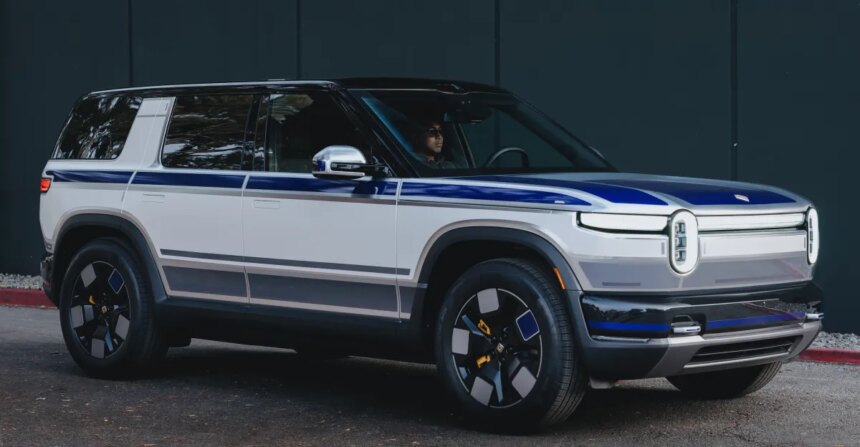
Rivian is stepping into the competitive world of autonomous driving technology by announcing the development of its own artificial intelligence (AI) chips, a move seen as essential for catching up to frontrunners like Tesla. During an event hosted at their Silicon Valley headquarters, Rivian introduced its proprietary silicon chip alongside plans for several autonomous features, ultimately aiming to deliver Level 4 autonomous vehicles to the market.
The newly unveiled chip, known as the Rivian Autonomy Processor, is a state-of-the-art piece of technology measuring just 5 nanometers. Taiwan Semiconductor Manufacturing Company (TSMC) will manufacture the chip, which integrates both processing capabilities and memory into a compact module. According to Rivian, this chip is designed to enhance efficiency and performance while complying with automotive safety standards.
At the event, Rivian’s CEO RJ Scaringe highlighted the company’s mission to deliver more time-efficient driving experiences for customers. The Rivian Autonomy Processor is equipped to handle approximately 800 trillion operations per second, with the third-generation computer setup achieving a staggering 1,600 trillion operations while making use of optimized data analysis.
Rivian aims to power its autonomous driving capabilities through an array of sensors, including lidar technology, which is set to be integrated into the upcoming R2 vehicles. This addition aims to provide redundancy and aid in real-time driving assessments—a feature that rivals like Waymo employ extensively. Rivian’s plans for lidar come amid a broader industry debate about the necessity and feasibility of integrating such technology into consumer vehicles, a challenge some competitors, like Volvo, have recently decided against.
In conjunction with the new chip technology, Rivian will introduce an AI-driven voice assistant designed to enhance user interaction with vehicle systems. This assistant will be integrated into both first- and second-generation R1 vehicles and will be capable of interfacing with third-party applications. Rivian’s approach will heavily rely on in-house development, augmented by external AI models to refine conversational capabilities and task execution.
Facing increasing pressure from investors and potential slowing sales—partially due to the expiration of federal electric vehicle tax credits—Rivian is attempting to carve out a sustainable niche within the increasingly crowded electric vehicle market. Despite substantial losses in recent years, the company reported its first positive gross profits earlier this year and is looking to software advancements as a new revenue stream through subscription services for its autonomous features.
An array of upcoming features has also been disclosed, targeting advancements in driver assistance capabilities. Among these are plans for hands-free driving, branded as Level 2 Plus, and the more advanced Level 3 “eyes-off” driving functionality, set to arrive in early 2026. Rivian plans to initially offer these features either as a one-time upgrade or through a monthly subscription model.
Rivian’s strategy positions it as a serious contender in an evolving landscape where legacy automakers such as Ford and GM have established their own advanced driving technologies. As Rivian prepares to rollout these ambitious initiatives, it remains to be seen whether the company can navigate the challenges of scaling production and technology in a race against its more established competitors.