In a remarkable display of growth, Rolls-Royce has witnessed an astonishing surge of over 1,200% in its share price since Tufan Erginbilgiç assumed the role of chief executive. This remarkable rise has led Erginbilgiç to set ambitious aspirations for the company, aiming to position Rolls-Royce as the largest company listed on the London Stock Exchange. Achieving this goal would require an increase in market value of around £124 billion ($167.34 billion), representing a substantial 110% growth from current levels.
The company is expected to shed light on its progress towards this ambitious target when it releases its full-year results later this week. After raising its financial guidance for 2025 during its interim results in July, Rolls-Royce has indicated that it anticipates an underlying operating profit between £3.1 billion and £3.2 billion, which is an increase from an earlier forecast of £2.7 billion to £2.9 billion. Following a trading update last November, market analysts have noted that the company’s performance remains in line with these expectations, with some foreseeing a slight outperformance relative to current guidance.
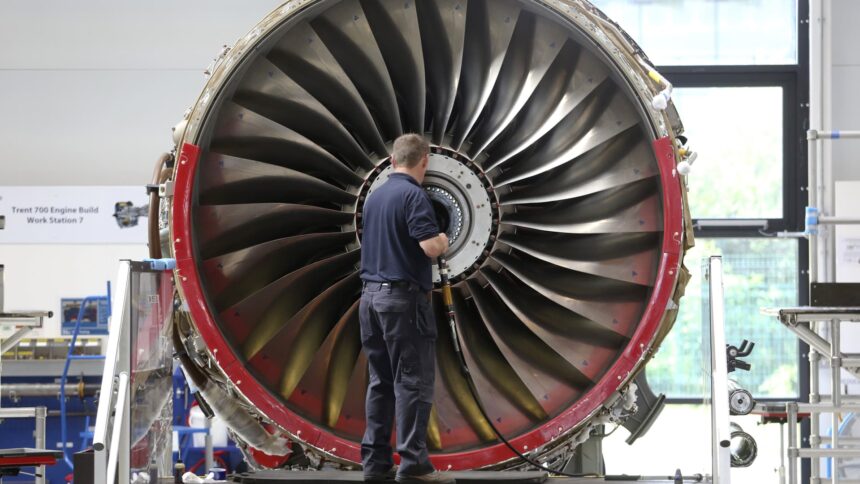
Analysts have underscored the robust growth being experienced across all three of Rolls-Royce’s primary sectors: civil aerospace, defense, and power systems. In the civil aerospace division, marked by significant new engine orders from carriers such as IndiGo and Malaysia Airlines, engine flying hours have surpassed pre-pandemic levels due to the continuing demand for maintenance services on older aircraft. This situation is further compounded by ongoing challenges faced by manufacturers like Airbus and Boeing in ramping up aircraft delivery rates.
In the defense sector, rising security concerns have induced increased public spending, which has positively impacted Rolls-Royce. The company’s share prices reached an all-time high last week amid reports suggesting that the U.K. government may expedite its defense expenditure target of 3% of GDP. Simultaneously, Rolls-Royce’s power systems division is tapping into the AI sector, catering to data centers worldwide while also contributing to energy grid resilience efforts.
The company’s recent innovations includes the introduction of a new modular solution for gas engine power plants aimed at bolstering energy supply security in Germany, particularly during periods when renewable energy generation diminishes due to unfavorable weather conditions, referred to locally as “dunkelflaute.”
Looking ahead, there exists considerable excitement surrounding Rolls-Royce’s endeavors in the nuclear energy space. The U.K. government has selected a consortium led by Rolls-Royce—including the Czech utility CEZ Group—to build three plants powered by small modular reactors (SMRs). This development builds on the company’s experience in providing nuclear-powered systems for the Royal Navy. Although the SMR business currently requires capital investment, Erginbilgiç has expressed optimism, projecting profitability and positive cash flow by 2030.
Additionally, there is notable interest in Rolls-Royce’s potential reinvolvement in the narrow-body aircraft engine market, a sector it exited in 2011 only to see significant unforeseen growth in demand. Erginbilgiç confirmed interest in re-entering this market, albeit likely in partnership with other entities.
As industry leaders like József Váradi, CEO of Wizz Air, and Michael O’Leary of Ryanair advocate for Rolls-Royce’s return to the short-haul engine supply market, investors remain curious about the company’s strategic plans and the potential for public subsidies to support development efforts.
Despite the optimism surrounding Rolls-Royce’s future, analysts caution that much of this potential growth may already be incorporated into the current share price. Given the company’s tumultuous journey, particularly during the pandemic, industry experts maintain that having such a dilemma is not a poor scenario to navigate for potential investors.