Salesforce’s recent fourth-quarter earnings reveal a robust financial performance, defying prevailing fears about the impact of artificial intelligence (AI) on its business operations. The company announced a significant revenue of $10.7 billion, marking a 13% increase compared to the previous year. Overall, Salesforce achieved $41.5 billion in revenue for the year, which is a 10% rise fueled in part by its $8 billion acquisition of Informatica, a data management firm, last May.
Net income stood impressively at $7.46 billion, and Salesforce provided optimistic guidance for the upcoming year, projecting revenue between $45.8 billion and $46.2 billion, reflecting an anticipated 10% to 11% growth. Additionally, Salesforce’s “remaining performance obligation” (RPO) has soared to over $72 billion, indicating strong future revenue expectations under contracts that have yet to be recognized.
Despite these figures, concerns loom over the software-as-a-service (SaaS) sector, particularly surrounding the rise of AI technologies that could potentially render traditional business models obsolete. This growing anxiety has led some investors to label the current climate as the “SaaSpocalypse.” During the earnings call, CEO Marc Benioff emphasized this term multiple times, suggesting that the SaaS industry has faced similar upheavals in the past and reaffirming the value of SaaS in today’s landscape. He humorously remarked, “If there is a SaaSpocalypse, it may be eaten by the Sasquatch,” alluding to the resilience of SaaS companies.
In a bid to bolster investor confidence, Salesforce unveiled several strategic moves. The company raised its dividend by nearly 6% to $0.44 per share and announced a $50 billion share buyback program, both of which are typically well-received by shareholders as they enhance stock value and demonstrate financial strength.
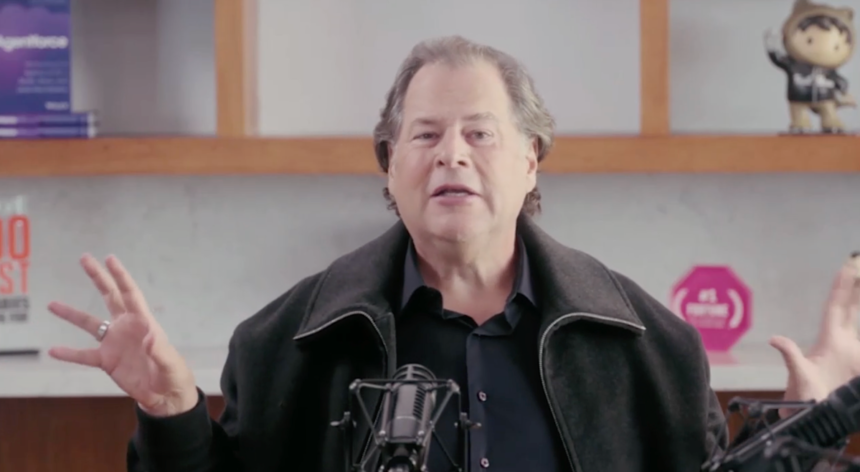
The format of the earnings call itself was notably unconventional, blending elements of a podcast, infomercial, and standard Q&A session. Benioff showcased testimonials from three prominent Salesforce customers—CEOs from SharkNinja, Wyndham Hotels and Resorts, and the SaaStr conference—who expressed enthusiasm for the company’s AI-driven products.
Additionally, Salesforce introduced a new metric termed “agentic work units” (AWU). This innovative measurement focuses on the completion of tasks by AI agents rather than simply counting “tokens,” which represents processing volume. AWU aims to provide a more meaningful assessment of an AI agent’s effectiveness in the enterprise environment.
To further navigate industry challenges, Salesforce presented a visionary architectural framework that positions its SaaS solutions as central to the tech ecosystem, while relegating AI model providers to a more commoditized role. This was a direct counter to a marketing thrust by OpenAI, which recently released its enterprise agent, Frontier, and showcased a competitive stack that places AI at the forefront.
In a visually striking moment during the call, Benioff donned a black leather jacket, reminiscent of Nvidia’s CEO Jensen Huang, who has been prominently recognized for his leadership in the burgeoning AI space. With this fierce and progressive approach, Salesforce aims to reassure investors about its ability to thrive amidst the evolving AI landscape.