







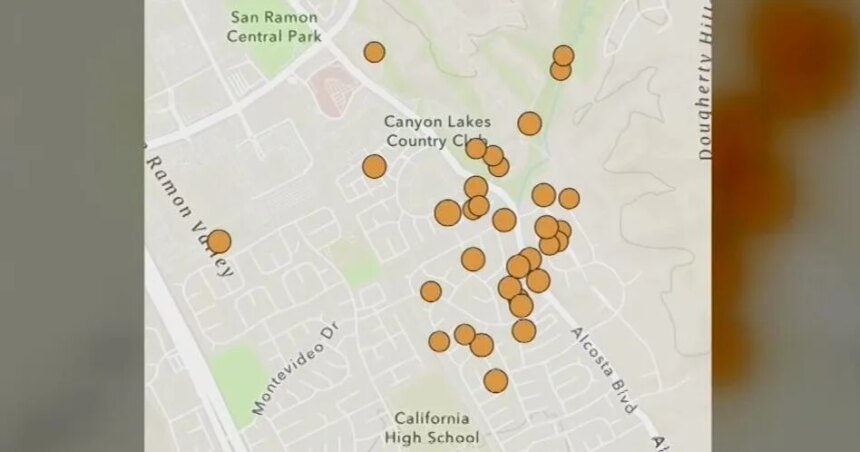
San Ramon has once again experienced a series of earthquakes, with a notable swarm occurring on Monday morning, December 8, 2025. This relatively small city, located atop the Calaveras Fault, has been the site of frequent seismic activity, particularly since November. The United States Geological Survey (USGS) has recorded these swarms over several decades, pointing to a historical pattern of minor earthquakes in the region.
Dr. Annemarie Baltay, a seismologist with the USGS, highlighted this ongoing phenomenon, discussing how these small tremors cluster unexpectedly. “The history shows swarms in 1970, 1976, 1990, 2002, 2003, 2015, and 2018,” she noted. The most recent upsurge includes seven mini-earthquakes that were felt between 2:00 AM and 10:00 AM in the neighborhood around Alcosta Boulevard. The nature and location of these seismic activities, Dr. Baltay explained, can be quite unpredictable, with past swarms manifesting in clusters that may “kind of move along in time.”
Residents of San Ramon experienced the shaking firsthand. Saif Hameed, a local resident, described how he felt the initial tremor that registered at a magnitude of 2.7 right beneath his home. “At 2:00 AM, the bed shook while we were sleeping, and the kids woke up, excited but also a bit scared,” he recounted. The tremors made him uneasy, especially considering a stronger quake, initially recorded at a magnitude of 3.7, occurred less than a mile from his house.
Hameed shared his mixed feelings about the earthquakes, expressing a desire for them to remain small. “It is exciting in a way, but it’s also scary,” he admitted, worried about the potential for a larger event. His neighbor, Lisa Bargenquast, echoed similar sentiments, sharing her frustrations as the shaking persisted. “You could hear the blinds and the house cracking,” she said, adding that she found herself yelling at the Earth to settle down.
As these minor quakes unfold, questions linger regarding the potential for larger seismic events. Dr. Baltay tempered these concerns, stating that while unexpected, the ongoing activity is typical for the area. “Yeah, I don’t know if I believe that, but I hope she’s right,” Hameed joked, acknowledging the unpredictable nature of geological phenomena.
Dr. Baltay also explained that earthquakes are generally recorded once they reach a magnitude of 2.0. She noted that the Earth is in a constant state of movement, and after major plates shift, they require time to readjust, often resulting in temporary swarms of small earthquakes. This cycle means that while residents may currently be on edge, there are periods of calm that follow such activity—something that the community surrounding Alcosta Boulevard could soon welcome.


