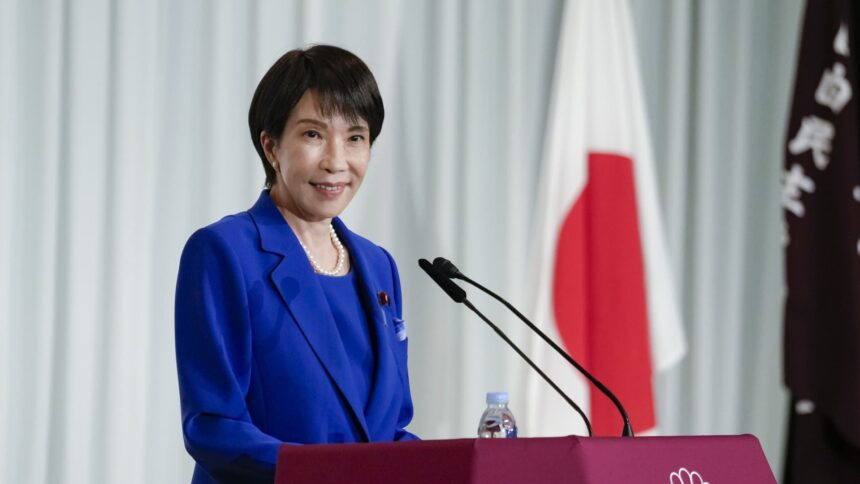
In a significant political shift for Japan, Sanae Takaichi has been elected as the new leader of the ruling Liberal Democratic Party (LDP), marking her as the first female leader of the party. This historic event took place during a vote held on October 4, 2025. Takaichi’s leadership is expected to have substantial implications for the country, as she is poised to become Japan’s first female prime minister.
Following her election, market reactions were robust. The Nikkei 225 index surged over 4%, reaching a record high. This surge was predominantly driven by strong performances in the real estate, technology, and consumer cyclical sectors. Key players in the market saw significant gains, with Japan Steel Works rising by 13%, while Mitsubishi Heavy Industries and Kawasaki Heavy Industries posted increases of 11% and 10.47%, respectively.
Economic analysts have been closely observing Takaichi’s stance on monetary policy, especially her probable alignment with the government’s “high-pressure economy” policy. According to notes from Crédit Agricole CIB, Takaichi is likely to advocate for the Bank of Japan to maintain its accommodative monetary policy. They noted the possibility of an increase in interest rates by 25 basis points by January 2026, reflecting Takaichi’s recognition of the current economic weaknesses.
The note highlighted expectations for a strategic overhaul under Takaichi’s administration, shifting towards a policy that emphasizes expanding investment and demand through public-private partnerships.
In tandem with the Nikkei’s rise, the Topix index also climbed over 3%, achieving an all-time high. Conversely, the Japanese yen experienced a decline, falling 1.45% to a rate of 149.59 against the U.S. dollar. Notably, Japanese bond yields reacted to the economic developments, with the 30-year bond yield increasing by over 10 basis points to 3.263%, and the 20-year debt yield rising more than six basis points to 2.674%. The 10-year bond yield remained relatively stable at around 1.659%.
In the broader Asia-Pacific region, Australia’s ASX/S&P 200 index saw a modest increase of 0.19%, while Hong Kong’s Hang Seng index showed positive signs with futures trading slightly higher. Markets in China and South Korea were closed for holidays.
The context of Takaichi’s rise coincides with positive trends in the U.S. markets as well, where major indexes recorded gains. The S&P 500 exhibited resilience amid a prolonged government shutdown, edging up by 0.01%. Meanwhile, the Dow Jones Industrial Average rose by 238.56 points, or 0.51%, while the Nasdaq Composite saw a minor decline of 0.28%.
As Japan prepares for a new chapter under Takaichi’s leadership, stakeholders from various sectors are keeping a close eye on potential policy shifts and their implications for the nation’s economy.