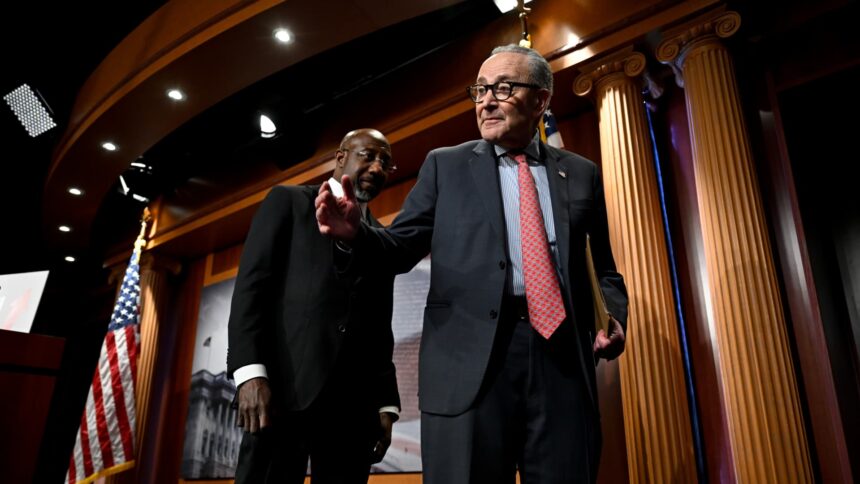
Senate Minority Leader Chuck Schumer and Senator Raphael Warnock recently held a news conference following the Senate’s rejection of a Republican plan to replace expiring Obamacare subsidies with federally funded health savings accounts. The focus now shifts to a vote on a Democratic proposal aimed at extending tax credits for health insurance purchased through the Affordable Care Act (ACA) marketplace.
As the deadline for ACA enrollment approaches, the debate between Democrats and Republicans over the continuation of enhanced premium subsidies has reached a stalemate. Experts emphasize that the central issue at hand is the affordability of health insurance in the United States. John Graves, a health policy professor, remarked that the core of this discussion is about how to aid citizens in affording their health insurance.
On a recent Thursday, two competing health measures were brought to the Senate floor but were unable to secure enough votes for advancement. This failure makes the expiration of enhanced subsidies at the year’s end seem increasingly likely, which could shift health care to a pivotal topic in the upcoming midterm elections.
Since 2020, ACA enrollment has risen significantly, particularly in states that were won by former President Trump in the 2024 election, leading to an 88% increase in enrollment over five years in those regions. Meanwhile, the Democratic proposal seeks a three-year extension of the enhanced subsidies, which have benefited around 22 million Americans—approximately 92% of those enrolled in ACA plans—by lowering their insurance premiums.
Without these enhanced subsidies, it is predicted that premium costs will more than double for many enrollees in 2026. Conversely, the Republican alternative suggests eliminating these enhanced subsidies in favor of direct payments into consumers’ health savings accounts. Both proposals failed to gain the necessary support in the Senate, despite backing from four Republican senators who chose to support the Democratic plan.
Observers like Chris Krueger of Washington Research Group pointed out the challenges in passing a viable bill within the limited legislative timeframe left this year. With Congress set to adjourn soon, the looming threat of a government shutdown at the end of January exacerbates the situation, particularly with unresolved issues related to ACA subsidies.
The ACA, or Obamacare, provides a crucial marketplace for individuals unable to obtain health insurance through other means, yet only about 24 million Americans accessed coverage through it in 2025. This number is dwarfed by the 68 million beneficiaries of Medicare and the 82 million enrolled in Medicaid and the Children’s Health Insurance Program, highlighting the varied landscape of health insurance coverage in the U.S.
According to the Kaiser Family Foundation, the average annual premium for family coverage through employers amounted to $27,000 in 2025, with employees contributing about 25% of that total. If enhanced ACA subsidies expire, families earning around $130,000 could face average premiums exceeding $23,900—substantially higher than the subsidized rate.
Supporters of the enhanced subsidies stress their importance in creating equity among various health insurance systems. These subsidies have functioned as a social contract, ensuring that no American has to pay more than a specific percentage of their income for insurance. Critics warn that allowing the subsidies to lapse would leave many families vulnerable to exorbitant costs.
The deadline for selecting an ACA health plan that ensures coverage starting January 2026 is December 15, and any enrollments made after this date will not take effect until February.
As the legislative impasse continues, experts warn that while extending subsidies is an immediate necessity to protect consumers from impending premium spikes, it only partially addresses the larger systemic issues contributing to escalating healthcare costs. The Republican proposal, which seeks to empower consumers with health savings accounts, is noted for its potential benefits but is ultimately criticized for not accommodating individuals with chronic conditions and those who cannot afford high-deductible plans.
In summary, the ongoing dispute characterizes a critical moment in U.S. health policy, with citizens and lawmakers alike awaiting resolution as they approach significant deadlines.