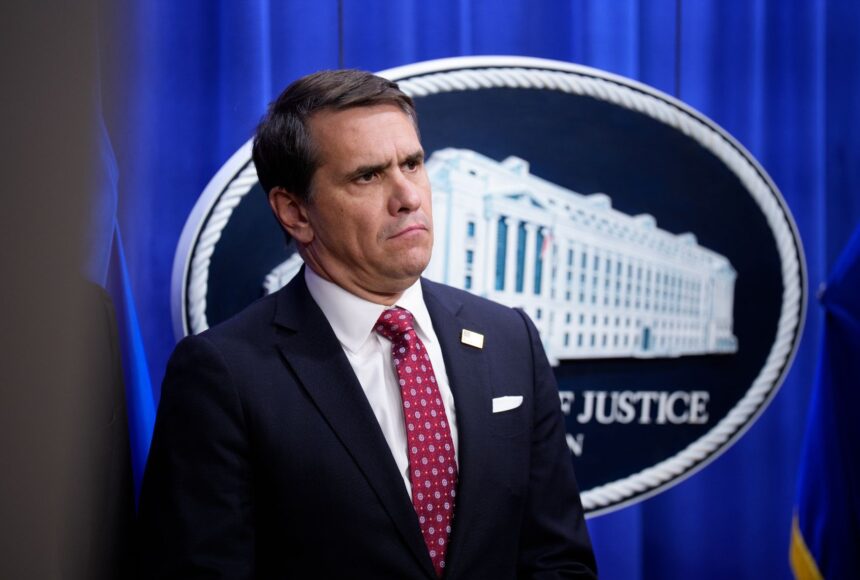
This week, six U.S. senators have raised serious allegations against Deputy Attorney General Todd Blanche, accusing him of a conflict of interest in his decision to terminate investigations into various cryptocurrency companies, dealers, and exchanges. The senators expressed concerns about Blanche discontinuing an enforcement team dedicated to investigating crypto-related fraud and money laundering.
In a letter penned by Democratic Senators Elizabeth Warren, Dick Durbin, Mazie Hirono, Sheldon Whitehouse, Christopher Coons, and Richard Blumenthal, they referenced a ProPublica investigation that revealed Blanche owned at least $159,000 worth of cryptocurrency assets during the time he ordered the cessation of these critical investigations. The senators, all members of the Senate Judiciary Committee, which oversees the Justice Department, previously alerted Blanche to their concerns that his actions could potentially serve President Donald Trump’s financial interests in the cryptocurrency sector.
Their latest letter to Blanche asserted that his actions may have violated federal conflict of interest laws. “Last year, we asked for the rationale behind your puzzling decision to scale back the Department of Justice’s cryptocurrency enforcement efforts and urged you to reconsider,” the senators wrote. “In light of recent reporting that you held substantial amounts of cryptocurrency at the time you made this decision, at the very least, you had a glaring conflict of interest and should have recused yourself.”
As the second-highest-ranking official at the Justice Department, Blanche had signed an ethics agreement in February stating he would divest from his cryptocurrency holdings within 90 days of his confirmation and would refrain from participating in any case that could financially benefit him until those assets were sold. Nonetheless, on April 7, before this divestment occurred, he distributed a memo titled “Ending Regulation by Prosecution.” In this memo, he criticized the Biden administration’s stringent stance on cryptocurrency as a misguided approach and announced the disbanding of the National Cryptocurrency Enforcement Team, which had been responsible for securing a number of high-profile convictions related to cryptocurrency misuse. Instead, Blanche indicated that the agency’s focus would shift to targeting only those who illegitimately utilized cryptocurrency for criminal purposes, such as terrorists and traffickers.
The senators promptly followed up with a letter urging Blanche to reconsider, warning that his decision could facilitate sanctions evasion, drug trafficking, scams, and child exploitation. In their most recent correspondence, they highlighted that their concerns had materialized, citing an independent report indicating a surge in illicit cryptocurrency activities in 2025, linked to money laundering and human trafficking.
Moreover, the letter suggested that Blanche’s decision may have been influenced by President Trump’s financial ventures, stating, “Certainly, President Trump’s financial interests seem to have motivated some of his pardons of criminals convicted of cryptocurrency-related crimes.” They further questioned Blanche’s motivations, given his substantial cryptocurrency holdings at the time of the policy change.
In a statement to ProPublica, a Justice Department spokesperson claimed that Blanche’s actions were adequately flagged and cleared in advance but did not specify who approved these measures or respond to the senators’ inquiries. In their latest letter, the senators demanded clarification regarding how and when Blanche’s actions were sanctioned and asked for a detailed account of any written determinations he received concerning the legality of his actions, as well as all communications he had with ethics and Justice Department officials on the matter.
The scrutiny comes on the heels of a request from the Campaign Legal Center, a nonpartisan watchdog organization, urging the Justice Department’s inspector general to investigate Blanche. The center’s general counsel, Kedric Payne, argued that Blanche’s orders benefited the cryptocurrency industry, including his personal investments, and estimated that the value of his Bitcoin holdings alone increased by 34%, reaching $105,881.53, between the issuance of his memo and his eventual divestment.
Under federal conflict-of-interest laws, government officials are barred from participating in matters that could financially benefit them unless they receive a special waiver. Violations of these statutes can result in severe penalties, including potential criminal charges.
“The public has a right to know that decisions are being made in the public’s best interest and not to benefit a government employee’s financial interests,” Payne stated in his complaint to the inspector general.
Notably, Blanche has a history as a federal prosecutor for the Southern District of New York and previously served as Trump’s lead attorney during trials that involved serious charges, including a hush-money scandal and accusations of election interference, both of which have since been dismissed after Trump’s reelection. The Campaign Legal Center has now expanded its investigation request, seeking an inquiry into whether Blanche violated his ethics agreements or federal statutes concerning conflicts of interest and false statements.