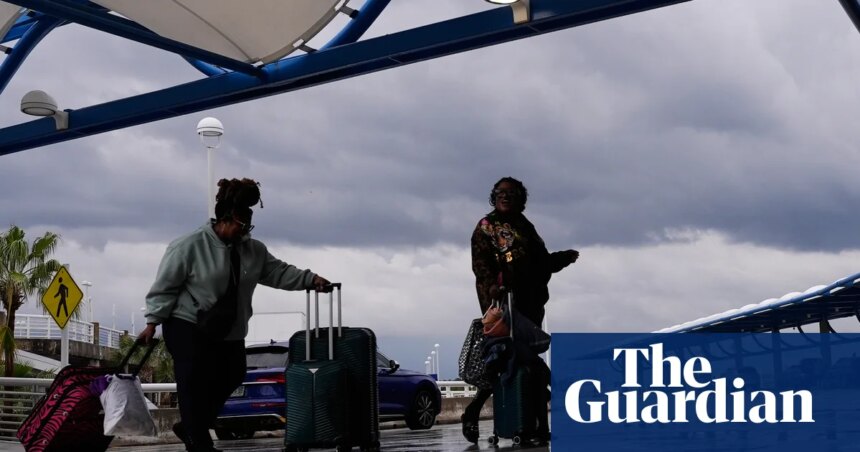
A late winter storm has wreaked havoc across the eastern United States, leading to significant travel disruptions as thousands of flights were either canceled or delayed. The storm’s powerful winds, combined with the repercussions of a partial government shutdown, have made airport security experiences exceptionally challenging for many travelers.
Flight tracking service FlightAware reported that by late afternoon, the number of delays within, into, or out of the US had reached an alarming 9,112, with cancellations totaling 4,763. Major airports in cities such as New York, Chicago, and Atlanta bore the brunt of these disruptions as travelers found themselves stranded or stuck awaiting updates.
The storm system, which initially dumped as much as 36 inches of snow in the Midwest, progressed eastward, bringing dangerously high winds and poses a risk of “strong and long-track tornadoes,” as warned by the National Weather Service. Areas from southern Pennsylvania to central South Carolina, affecting cities like Washington DC, Baltimore, Richmond, and Raleigh, are predicted to experience severe weather conditions. Furthermore, AccuWeather forecasts indicate that some regions in the southwestern United States could face “dangerously hot conditions” that might lead to record-breaking temperatures.
AccuWeather senior meteorologist Adam Douty remarked on the unusual mix of winter and spring hazards, noting that over 200 million individuals could be affected by this extreme weather event, with conditions varying from blizzards to severe thunderstorms and strong winds across numerous states.
Travelers have found themselves unexpectedly grounded. Kelly Price, who was attempting to return to Colorado from Florida, expressed her frustration upon learning her flight was canceled early Monday morning, leaving her family with no option but to sleep on the airport floor. The first available flight she could book was not until Tuesday afternoon.
In light of the severe weather conditions, the Federal Aviation Administration (FAA) enacted ground stops at Hartsfield-Jackson and Charlotte Douglas airports and ground delays at JFK and Newark Liberty airports. Compounding the situation, the timing of these storms coincided with a partial government shutdown that has affected the Department of Homeland Security, which encompasses the Transportation Security Administration (TSA). This is the third government shutdown in less than a year, leaving TSA workers to go without their first full paycheck. This further exacerbated staffing shortages at numerous airports.
Some facilities have reported longer security lines as an increasing number of TSA workers are seeking additional jobs, unable to afford commuting costs, or opting to leave the profession altogether. Data shows that over 300 TSA agents have resigned since the onset of the shutdown. Local union representatives have highlighted the severe financial strain faced by many TSA employees, including eviction threats and heavy financial burdens.
Aaron Barker, a local leader with the American Federation of Government Employees, conveyed the frustration of TSA workers during a news conference outside Hartsfield-Jackson airport. “To be quite frank, officers are pissed off,” he stated, reflecting sentiments shared by employees nationwide.
While TSA workers express their grievances, travelers are urged to arrive hours in advance to board their flights, which may still be canceled due to the ongoing weather chaos. Specifically, those flying from Louis Armstrong airport in New Orleans were advised to arrive at least three hours early, noting the compounded delays caused by the government shutdown.