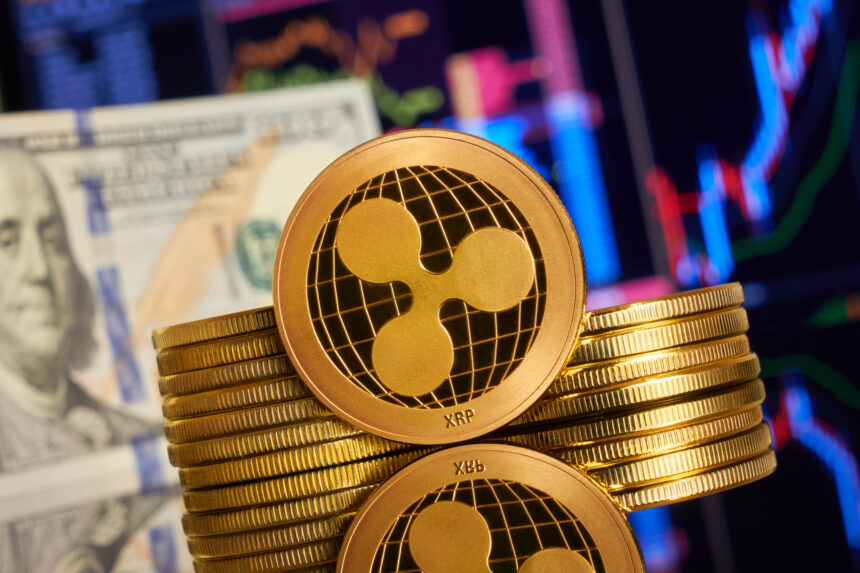
XRP has experienced a remarkable surge in value over the past year, largely fueled by positive political outcomes, including the recent presidential election results, and the conclusion of a lengthy legal battle involving the cryptocurrency. In just two months towards the end of 2024, the digital asset saw its value skyrocket from $0.50 to an impressive $2.70, with further appreciation noted in the following year. This rally peaked with XRP reaching an all-time high of $3.56 in July, before settling back to $2.20 by November 6.
Despite this impressive rally, analysts caution potential investors about jumping on the bandwagon. In fact, many argue that XRP is currently overvalued, even as prices hover below the $2.50 mark. Analyzing market indicators, XRP has shown a recent change of 5.06% at a price point of $2.33 and a market capitalization around $140 billion. Comparatively, its trading range over the last 52 weeks has fluctuated between $0.54 and $3.65.
One critical perspective comes from evaluating the operational fundamentals of RippleNet, the platform’s payment service. For the quarter ending on September 30, 2025, RippleNet managed $57.7 billion in total payment volume (TPV). While this figure is significant, it pales in comparison to PayPal, a key player in digital payments, which processed $458.1 billion in TPV during the same timeframe. Although RippleNet is recognized for its speedy transaction capabilities and lower fees, its revenue generation is likely considerably less than PayPal’s reported $8.4 billion profits.
Critics draw attention to the inherent differences between XRP and other valuable assets like gold or real estate. Unlike these commodities, the valuation of XRP cannot be sustained by physical limitations or extensive mining operations. Instead, XRP’s supply dynamics are controlled by Ripple, which released a total of 100 billion coins upon launch in 2014 and retains 40 billion in reserve. This inherent control over circulating supply questions the asset’s sustainability in a wealth management context, with some suggesting that XRP behaves more akin to a meme coin rather than a robust digital asset.
Adding to the skepticism is XRP’s hefty market cap of approximately $134 billion, which some analysts deem unsubstantiated. When taking into account the full supply of 100 billion coins, the fully diluted market value swells to $220 billion, positioning XRP close to major financial institutions like Goldman Sachs and American Express. Many experts argue that such a comparison is premature and overly speculative, emphasizing that XRP would need to establish more solid market fundamentals before approaching such valuations.
Thus, many investors express reluctance to engage with XRP at current prices. Observers note a stagnation in the pace of RippleNet’s advancements within the global economy, pointing out that payment volumes are not experiencing significant growth and new partnerships are scarce. While there remains hope for RippleNet’s future developments, current market conditions do not inspire confidence in XRP’s soaring prices.