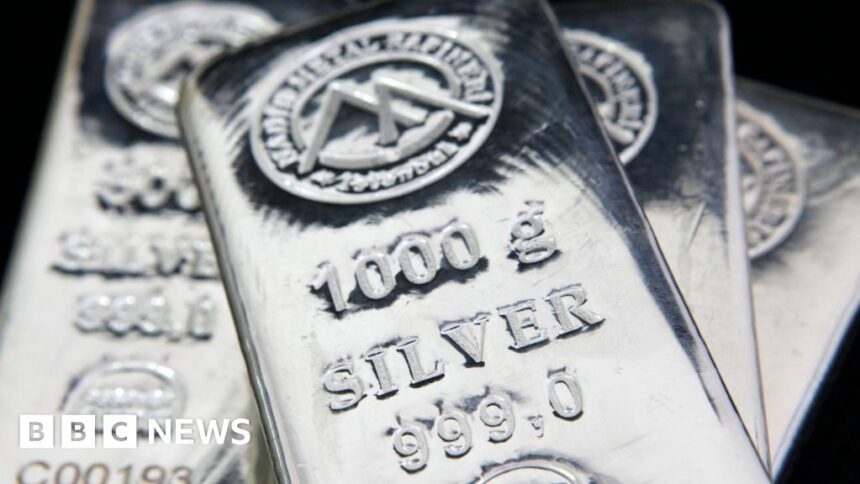
The price of silver surged to a record high, crossing $60 an ounce on the spot market, as investors anticipate a reduction in US Federal Reserve interest rates and the technology sector’s robust demand for the metal. This milestone marks the first time silver has reached this price point, reflecting shifting investor behavior amidst economic uncertainties.
As concerns about US tariffs and the overall global economic outlook escalated earlier this year, gold prices had already hit record levels, contributing further to the appeal of precious metals. This week, gold continued its upward trajectory amidst expectations that the US central bank will lower its main interest rate by a quarter of a percentage point in the near future.
Yeow Hee Chua, an academic from Nanyang Technological University, explained that lower interest rates often prompt investors to shift their focus toward assets perceived as better stores of value, such as silver and gold. When interest rates decline, the advantages of keeping cash or investing in short-term bonds diminish, leading traders to seek refuge in precious metals.
The shift toward these “safe-haven” assets has played a critical role in gold’s recent price surge, which surpassed $4,000 an ounce. Additionally, silver’s current rally has been interpreted as a “spillover effect” from the rise in gold prices, with investors looking for more affordable alternatives.
Analysts have noted that 2023 has seen gold prices increase by more than 50%, largely driven by significant purchases made by central banks. Simultaneously, the values of platinum and palladium have also experienced upward momentum.
Experts attribute part of silver’s price increase to heightened demand from the technology industry, which has outpaced supply. This surge has resulted in more than a twofold increase in silver prices this year, positioning it as a more attractive investment compared to other precious metals.
Kosmas Marinakis, from Singapore Management University, highlighted silver’s dual role as both an investment asset and a critical physical resource, noting that manufacturers are increasingly dependent on it. Due to its superior electrical conductivity compared to gold or copper, silver is essential for the production of items like electric vehicles (EVs) and solar panels. The accelerating sales of EVs are expected to further elevate silver demand, especially since new battery technologies will require even more of the metal.
However, the ability to rapidly increase silver supplies is limited, as a significant portion of global silver production is a by-product of mining for other metals, such as lead, copper, and gold. This constraint on supply, coupled with the ongoing threat of potential tariffs from the US, has contributed to an environment of scarcity. Stockpiling by manufacturers in anticipation of these tariffs has led to shortages in other parts of the world.
The United States imports approximately two-thirds of its silver, which is utilized in manufacturing, jewelry, and investment. Manufacturers are hurriedly securing their supplies to prevent disruptions in their operations caused by potential shortages, further driving up prices on international markets.
With signs indicating that the price of silver may remain elevated in the coming months, experts are closely monitoring market conditions and the evolving landscape of demand across various sectors.