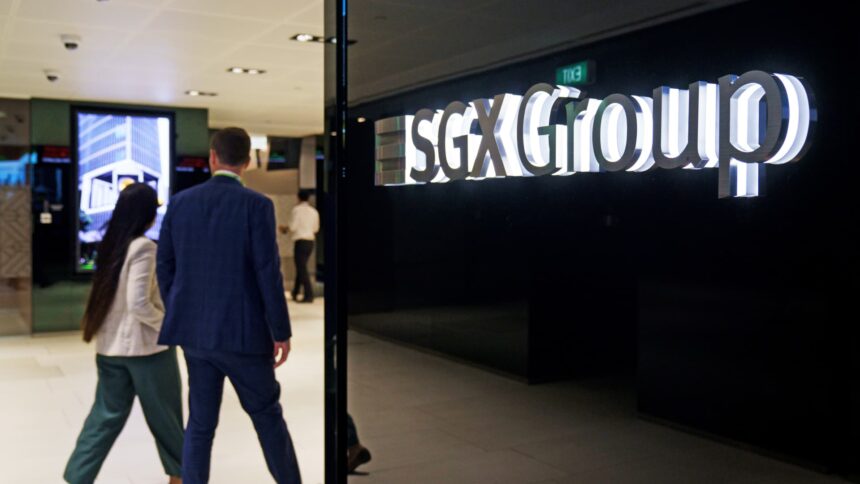
Singapore is intensifying its efforts to enhance the appeal of its stock market for both companies and investors. In a strategic move, the Singapore Exchange (SGX) has partnered with Nasdaq to facilitate dual listings between the U.S. and Singapore through a new initiative called the “Global Listing Board.” This initiative is specifically designed for companies with a market capitalization exceeding 2 billion Singapore dollars (approximately $1.5 billion).
The “Global Listing Board” aims to provide companies with streamlined access to global capital and investors, with a focus on creating a unified cross-border listing framework linking the two exchanges. According to a joint statement from Nasdaq and SGX, one of the key features will be the simplification of regulatory requirements, allowing firms to fill out a single set of paperwork for compliance on both exchanges. This streamlined process is expected to be fully operational by mid-2026.
SGX CEO Loh Boon Chye emphasized the advantages for investors in a discussion with CNBC, explaining that the dual listing across different time zones would enable continuous price discovery. He noted that this setup allows investors to manage risk effectively around the clock, offering choices for transactions in either U.S. or Singapore dollars.
Nasdaq CEO Adena Friedman praised the initiative as the “first of its kind,” highlighting its potential to attract companies with an Asian presence that seek global exposure while navigating a singular regulatory framework.
This announcement coincides with additional measures from the Monetary Authority of Singapore (MAS) aimed at bolstering the competitiveness of the local stock market. Among these initiatives is a SG$30 million “Value Unlock” package intended to enhance corporate strategy, capital optimization, and investor relations. MAS stated that this is an opportune moment for companies to highlight their strategic fundamentals and demonstrate value creation to entice investor interest.
Furthermore, MAS has committed SG$2.85 billion to six asset managers in Singapore, complementing an earlier SG$1.1 billion allocation made in July. This funding effort is geared toward developing the country’s fund management industry and promoting greater investor participation in Singapore’s equity markets.
Analysts from CGS International remarked that the liquidity enhancement is a positive development for the Singapore stock market, suggesting that initiatives like the “Value Unlock” program are beneficial to the overall value chain. They noted an uptick in activity within Singapore’s equity market, with average daily turnover rising 16% year-on-year to SG$1.53 billion in the third quarter of 2025—the highest level recorded since early 2021. This growth has particularly been evident in the trading of small- and mid-cap stocks, along with a surge in initial public offerings (IPOs), which have collectively raised over SG$2 billion this year.
However, CGS International cautioned that while dual listings could potentially broaden access for regional investors, challenges such as the relatively lower liquidity of the SGX compared to the Nasdaq remain significant near-term obstacles.
Additionally, Goldman Sachs analysts noted that while the details and enforcement measures surrounding the “Value Unlock” program are not yet fully defined, recent interactions with investors suggest that corporate actions will be essential for any further re-rating of the Singapore market. They pointed to Japan and South Korea, which have instituted measures like dividend tax cuts to encourage corporate actions and foster market growth. Following the establishment of the equities review group in August 2024, Singapore’s Straits Times Index (STI) has experienced an increase of approximately 30%, a stark contrast to the nearly 60% growth seen in the equity markets of Japan and South Korea following the announcement of their respective reforms.