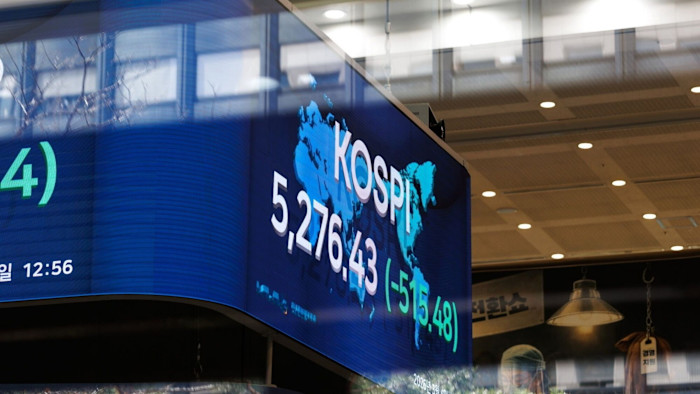
South Korean equities witnessed an unprecedented plunge, with the benchmark Kospi index dropping 12 percent in a single day, marking the largest one-day decline in history. This significant downturn comes as global markets react to escalating fears surrounding a prolonged conflict in the Middle East, which has already begun to impact the world’s eighth-largest oil importer significantly.
The Kospi index, which started the year as a standout performer with an impressive gain of nearly 50 percent in the initial months, has now experienced a nearly 20 percent decline since Friday. Investors are concerned that the ongoing war in the Middle East could disrupt oil supplies, leading to unfavorable economic conditions in South Korea. Jason Lui, head of Asia-Pacific equities and derivatives strategy at BNP Paribas, noted that many investors are attempting to capitalize on profits from what was one of the strongest markets this year. Some are even factoring in a scenario involving severe disruptions due to the conflict.
The sell-off was heavily influenced by significant declines in major companies, particularly Samsung Electronics and SK Hynix. As the world’s two largest memory chip manufacturers, these firms are pivotal to the Kospi index, collectively comprising nearly 40 percent of its total value. Since the onset of the conflict, both companies have seen their stock prices decrease by approximately 20 percent.
Across East Asia, markets reacted similarly, reflecting the region’s reliance on energy imports. Japan’s Topix index fell by 3.7 percent, while Taiwan’s Taiex tumbled by 4.4 percent. In China, significant losses were recorded with the Hang Seng index dropping by 2 percent and the CSI 300 index losing 1.1 percent. These declines were accompanied by a rise in Brent crude oil prices, which increased by 2.5 percent to reach $83.40 per barrel.
The sell-off has seen foreign investors offload a staggering net of 5 trillion won (approximately $3.4 billion) in Kospi shares since the beginning of the week. This mass selling has heightened volatility in the market, with the Kospi 200 volatility index soaring to its highest level since March 2020. The heavy influx of foreign sales has further strained the Korean won, which has weakened by 2.5 percent in just two days, briefly crossing the Won1,500 mark against the dollar—its weakest point since the global financial crisis.
Economic analysts warn that given South Korea’s status as a major oil importer, the rising oil prices could lead to substantial adverse effects on the country’s economy, including inflation, exchange rate pressures, and overall growth—a concern that intensifies if the conflict continues for an extended period. Jongmin Shim, an equity strategist at CLSA, indicated that the market’s downward spiral is also exacerbated by the unwinding of leveraged stock purchases by retail investors, who had been instrumental in driving the market surge earlier this year.
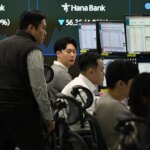
The sharp decline has sparked panic among many retail investors. One affected individual, 60-year-old Song Mi-kyung, expressed her distress, stating, “I’m having a meltdown. I’ve never seen a freefall like this in my decades of stock investing, even when a war broke out.” She added that her only hope now is for a swift recovery in the markets.
In response to the tumultuous market conditions, the Bank of Korea has announced it will closely monitor the situation and implement measures should it detect any “excessive moves” in the currency market. The bank’s scrutiny comes amidst concerns that Korea’s agreement to invest $350 billion in the U.S. as part of a trade deal aimed at easing high American tariffs may exert additional pressure on the won moving forward.