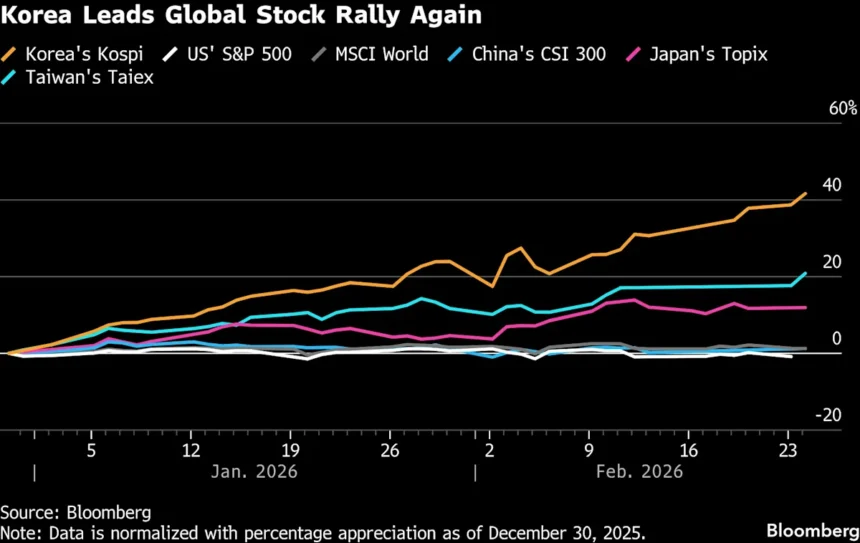
South Korea’s equity market has reached a remarkable new high, with the Kospi Index climbing to an unprecedented 6,123 points, marking a 2.6% increase on Wednesday. This surge follows the index’s recent milestone of surpassing the 5,000 mark just a month prior, fueled by a global uptick in memory demand that significantly benefits the country’s major semiconductor manufacturers.
The strong performance of Samsung Electronics Co. and SK Hynix Inc., both gaining over 2%, contributed notably to this historic rise. The Kospi’s gains for the year have now reached 45%, allowing South Korea’s stock market capitalization to surpass that of France and echoing last month’s ascension over Germany.
Traditionally undervalued and often ignored by foreign investment, Korean stocks have transformed into standout performers on the global stage. This turnaround is attributed to the surge in the so-called “AI scare trade.” Unlike many markets that have rallied on software stocks, Korea has seen its hardware firms propel the stock index higher. Furthermore, recently enacted corporate governance reforms, including an impending bill mandating companies to cancel treasury shares, have invigorated investor confidence.
The current rally can also be linked to a broader tech resurgence, ignited by Meta Platforms Inc.’s significant agreement with Advanced Micro Devices Inc. to use its chips and computers for AI applications. Analysts, however, caution that while the Kospi’s recent surge is impressive, future gains may be more moderate and contingent upon consistent earnings growth beyond the semiconductor sector.
Analysts like Jung In Yun of Fibonacci Asset Management Global highlight the importance of sustainable performance, noting that the market’s stability will rely on a diverse range of companies contributing to growth, rather than depending primarily on semiconductor giants.
Additionally, a recent ruling by the U.S. Supreme Court that eliminated reciprocal tariffs initiated by former President Donald Trump is expected to further enhance the appeal of Korean equities. Portfolio manager Tiffany Hsiao at Matthews anticipates that this development could favor Korean exporters, particularly those within the electronics and component sectors that are heavily tied to U.S. consumer demand.
Interestingly, a revival in interest from retail investors, who have historically favored U.S. stocks over local options, is emerging. If this trend continues, it could catalyze another phase of the stock market rally.
In late January, South Korea’s market capitalization had already exceeded that of Germany, and this week it reached $3.76 trillion, surpassing France – a notable achievement considering the size of the underlying economies. Such rapid growth typically raises concerns among market observers who are now vigilantly assessing valuations.
While some investors express hesitation, citing the rapid ascent of the Kospi, others maintain an optimistic outlook. For instance, analysts at Citigroup Inc. and Macquarie Capital have recently adjusted their target prices upwards. Macquarie projects a 65% upside for Samsung shares, bolstered by ongoing demand in the memory sector and sustained interest in AI technologies.
Nomura analysts have set an ambitious target for the Kospi, forecasting it could reach as high as 8,000 within the first half of the year, citing favorable conditions such as a memory supercycle, robust earnings from AI-related capital expenditures, and improvements in the defense sector.
According to Nomura, the realization of this bullish trajectory will depend on the South Korean government’s ability to implement promised reforms, particularly those addressing corporate governance and enhancing operational frameworks. The proposed requirement for companies to cancel treasury shares is seen as a critical step toward harmonizing control structures within large conglomerates, often viewed as barriers to broader market reform.
In summary, while the South Korean stock market has entered a historic phase of growth, analysts agree that the sustainability of this trend hinges on broader participation from various sectors and the successful delivery of governmental reforms aimed at enhancing corporate governance and operational transparency.