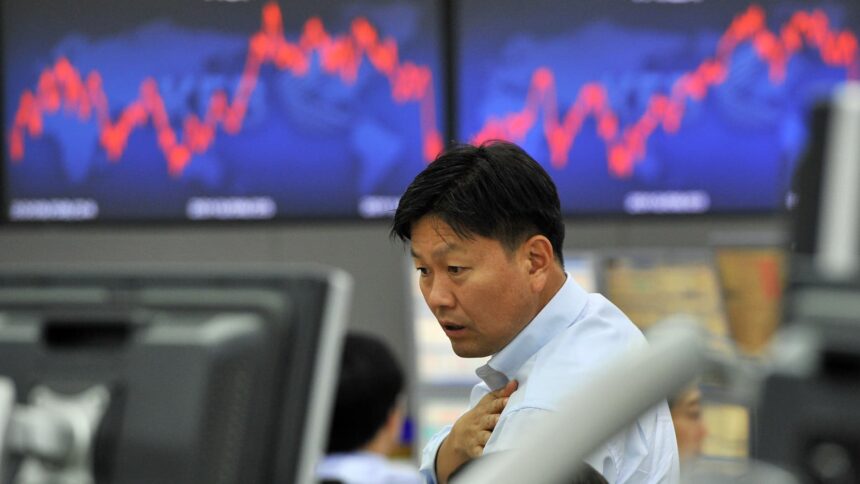
A significant downturn in South Korea’s stock market has captured attention as the Kospi index plummeted over 12% on Wednesday. Although it later reclaimed some losses, the sharp decline marked a continuation of a hefty sell-off from the previous trading session, primarily driven by escalating tensions in the Middle East.
In response to the volatility, trading for the Kospi was temporarily halted. The Kosdaq also experienced severe pressure, triggering a circuit breaker that led to a nearly 13% drop. Ultimately, the Kospi index closed down approximately 8%, with major players like SK Hynix and Samsung Electronics suffering declines of more than 6% and over 9%, respectively. This downturn is particularly striking given that the South Korean market had enjoyed a robust performance last year, rising by more than 75%.
Lorraine Tan, the Asia director of equity research at Morningstar, attributed much of the decline to the concentration of individual stocks within the Korean markets. Notably, Samsung and SK Hynix account for nearly 50% of the Kospi index. Tan noted that the fall in stock prices reflects profit-taking after an extensive run-up while indicating growing fears that the pace of AI data center adoption may slow owing to elevated energy costs compared to traditional data centers.
The sensitivity of South Korea’s stock market to fluctuations in oil prices has also come into play. Daniel Yoo, a global market strategist at Yuanta Securities, emphasized that geopolitical stress in the Middle East tends to provoke short-term volatility. As a major oil importer, South Korea’s manufacturing-driven economy faces vulnerabilities from surging energy costs, which can strain both industrial and export-oriented sectors. Yoo assessed the Kospi’s recent slump as a correction following a strong rally rather than a fundamental alteration in market sentiment, suggesting that stability should return once oil prices stabilize.
In a broader context, other Asian markets mirrored this bearish sentiment. Japan’s Nikkei 225 index dipped by 3.88%, while the Topix fell by 3.96%. Investors are also focusing closely on China, where an annual parliamentary meeting, known as the “Two Sessions,” is scheduled to commence later in the day. Chinese Premier Li Qiang is expected to declare several economic targets during the National People’s Congress, which will begin on Thursday.
Simultaneously, Australia’s S&P/ASX 200 dropped more than 2%, and Hong Kong’s Hang Seng index decreased by over 2.74%. The mainland CSI 300 index also fell, losing 1.61%. A report indicated that factory activity in China faltered in February as production and shipments were paused to celebrate an extended holiday; the official manufacturing purchasing managers index (PMI) fell to 49, missing economists’ projections.
On the commodities front, oil prices continued to rise amid the escalating conflict, with U.S. crude futures increasing by 0.5% to $74.93 a barrel. Brent crude rose 0.95% to $82.17. Tensions have mounted as a senior commander of Iran’s Revolutionary Guard claimed to have shut the strategic Strait of Hormuz and signaled that vessels navigating the waterway would be targeted.
In stark contrast, precious metals saw price increases, with spot gold advancing 1.64% to $5,170 per ounce, and spot silver leaping nearly 3% to $84.49 per ounce.
In the United States, previous trading sessions reflected similar anxieties, as market apprehensions about an extended U.S.-Iran conflict spurred fluctuations. The Dow Jones Industrial Average fell by 403.51 points, or 0.83%, concluding at 48,501.27, while the S&P 500 slipped 0.94% to finish at 6,816.63. The Nasdaq Composite recorded a decline of 1.02%, settling at 22,516.69. At their lowest points during the day, both the S&P 500 and Nasdaq experienced drops of around 2.5% and 2.7%, respectively, while the Dow was down over 1,200 points at its nadir.