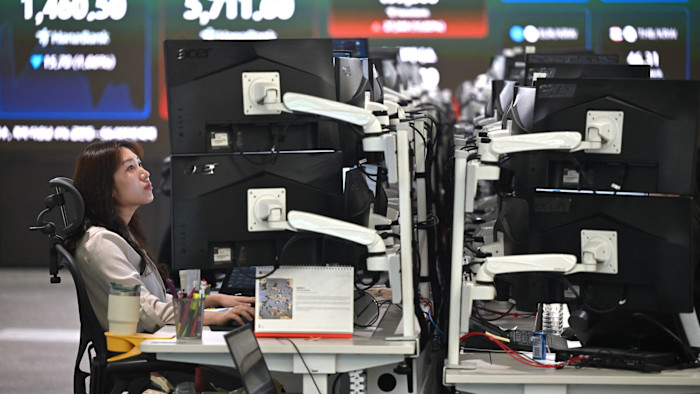
South Korea’s stock market experienced a significant rebound on Thursday, recovering from a steep decline driven by rising concerns over a prolonged conflict in the Middle East. The Kospi benchmark index surged by 10 percent after President Lee Jae Myung announced the activation of a market stabilization fund worth 100 trillion won (approximately $68 billion). This intervention marked a notable response amidst fears that escalating tensions in the region could critically impact oil and gas imports.
In addition to South Korea’s recovery, other Asian markets also posted gains, with Japan’s Topix rising by 2 percent, Taiwan’s Taiex jumping 2.6 percent, Hong Kong’s Hang Seng index advancing 0.3 percent, and mainland China’s CSI 300 increasing by 1 percent. The collective rise followed a day of substantial losses across Asian equity markets, which had been spurred by worries about the economic repercussions of a potential extended war in Iran—most notably affecting nations dependent on imported energy.
The Kospi had suffered particularly severe losses, plummeting 12 percent in what was the index’s largest single-day drop amid the unfolding crisis. The swift government response, marking one of the first acts of public intervention since the onset of tensions in the Middle East, was geared toward stabilizing market conditions. President Lee addressed his cabinet, highlighting the expected difficulties the country would face in terms of energy supply, economic stability, and industrial performance due to the growing volatility in financial markets.
Before the outbreak of tension surrounding Iran, South Korea’s stock market had been thriving, having recorded a nearly 50 percent rise in the initial two months of the year, buoyed by corporate governance reforms and advancements in artificial intelligence (AI). Major companies such as Samsung Electronics and SK Hynix, which together account for nearly 40 percent of the Kospi index due to their production of memory chips for AI data centers, both saw their shares rise by 11 percent on Thursday.
Market analysts suggest that the sharp rise in the Kospi may have attracted short-term leveraged investments, which contributed to the volatility experienced recently. Joshua Crabb, head of Asia-Pacific equities at Robeco, noted that the mid-week market tensions acted as a catalyst for profit-taking, although he remains optimistic about South Korea’s economic fundamentals, provided that the conflict in Iran does not worsen.
Given that South Korea imports nearly all of its oil—70 percent of which comes from the Middle East—any extended disruptions could have serious implications for the nation’s corporate sector. Analysts from Morgan Stanley echoed these views, indicating that a prolonged US-Iran conflict could negatively affect corporate earnings, although they maintain a positive outlook on the technology and industrial sectors in the medium term.
In the wake of the government’s market stabilization efforts, An Hyungjin, CEO of Seoul-based hedge fund Billionfold Asset Management, expressed that while investor sentiment remains mixed, the government’s action has provided some psychological reassurance as the market navigates through this turbulent period. Investors are currently balancing desires for profit-taking and bargain-hunting, a dynamic that suggests ongoing volatility could be expected in the near future.