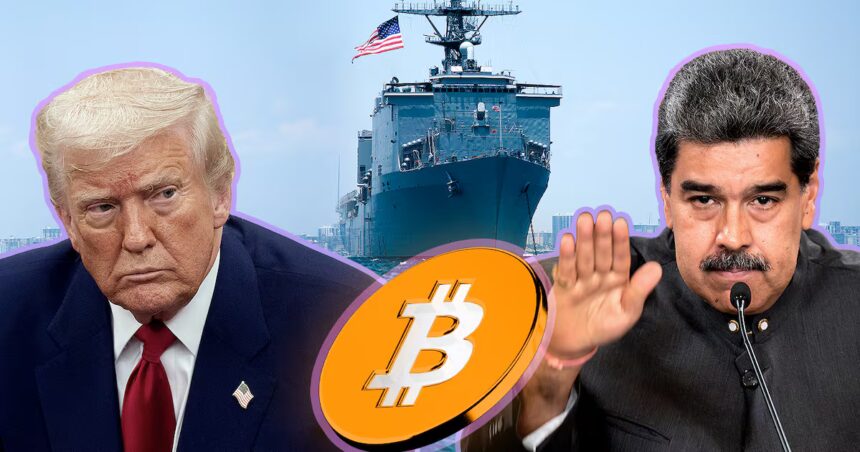
Speculation has intensified regarding the possibility of Venezuela holding a significant stash of Bitcoin, particularly following the recent capture of President Nicolás Maduro. As discussions swirl on social media platforms like Crypto Twitter, questions arise about whether the country possesses a stockpile of Bitcoin and, if so, how substantial it might be.
Venezuela has suffered from hyperinflation for decades, compelling many of its citizens to seek refuge in digital assets. According to a report by TRM Labs, Venezuela was projected to be the 11th highest country for digital asset adoption by 2025. However, the existence of a large Bitcoin reserve held by the Maduro regime remains uncertain, with concrete evidence lacking.
A widely circulated newsletter by Bradley Hope’s Whale Hunting posits that the Maduro regime may be sitting on as much as 600,000 Bitcoin, a hypothetical figure that translates to billions of dollars. Nevertheless, blockchain forensics firms have reported difficulty in locating any Bitcoin holdings linked to the Venezuelan government. Matteo Colledan, a vice president at the blockchain surveillance firm Arkham, stated, “We have not identified any such holdings at present” and mentioned ongoing investigations to assess whether any reserves exist.
Further corroborating these findings, Ari Redbord, Global Head of Policy at TRM Labs, explained that while they are looking for a centralized government cache of Bitcoin, the nation’s engagement with cryptocurrency appears to be more “fragmented, opportunistic, and adaptive.” The current data does not support the notion of a substantial, centrally managed Bitcoin treasury belonging to Venezuela.
Despite the skepticism surrounding government holdings, Venezuela’s relationship with cryptocurrency is evident. In 2018, the government launched the Petro, an oil-backed digital currency that faced widespread criticism as a means for evading international sanctions. Reports from TRM Labs indicate that state entities have been instructed to utilize digital assets for oil-related and cross-border transactions. Additionally, amid soaring inflation—recorded at 500% in 2025—many Venezuelans have turned to stablecoins and Bitcoin to stabilize their financial situations. The country’s relatively low energy costs have also spurred growth in Bitcoin mining, although government crackdowns on unauthorized operations have led to equipment seizures.
Notably, opposition leader and Nobel Peace Prize winner Maria Corina Machado has described Bitcoin as a “vital means of resistance” for the Venezuelan populace, emphasizing the grassroots adoption of cryptocurrency in the face of economic hardship. However, this widespread individual use of Bitcoin does not equate to the possession of a hidden governmental treasury.
The notion of a substantial Bitcoin reserve tied to the Venezuelan government remains speculative, and experts suggest that if such a trove does exist, it may be exceptionally well-concealed. As investigations continue, the reality of Venezuela’s cryptocurrency landscape remains an evolving narrative fraught with uncertainty.