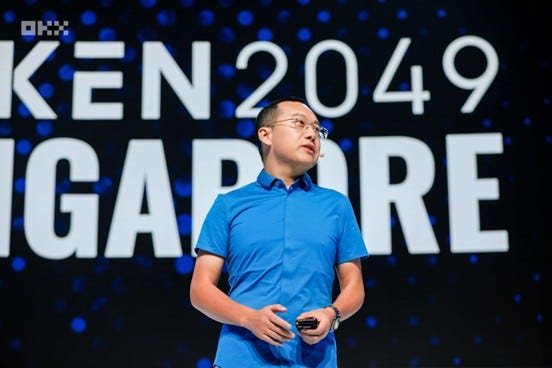
On October 1, Star Xu, the founder and CEO of OKX, made a significant appearance at the Token2049 summit in Singapore, delivering an impactful keynote titled “Everything Onchain, Self-Custody Is the Future.” His address focused on a pivotal shift in the financial landscape, asserting that the future is characterized by users having direct control over their assets rather than relying on institutions for custodianship. Xu drew parallels between the evolution of the internet and finance, suggesting that just as the internet moved from closed systems to open protocols, finance is now progressing in a similar manner.
During his speech, Xu highlighted the transition from a model of “trust first, verify later” to one of “verify first, then trust.” He asserted that self-custody is not just a trend but the cornerstone of future financial systems, stating, “The future of finance is not in vaults, but in your crypto wallet.” In a follow-up post on the X platform, he reiterated this vision, emphasizing that the development of finance will occur openly and transparently onchain.
Xu elaborated on why everything should migrate on-chain, recalling his early days at OKX, when Bitcoin was viewed as an exotic curiosity. He described significant advancements in public blockchains, such as Ethereum and Solana, which have emerged as foundational elements for decentralized applications (dApps). He noted that the traditional finance sector largely operates within closed environments, whereas decentralized finance (DeFi) offers transparency and innovation, enabling anyone to build applications.
The four core principles defining a true on-chain system, according to Xu, are openness and transparency, the ability for anyone to develop within the system, freedom for users to switch providers, and ensuring a global reach. He is optimistic that a wide range of assets, including tokenized securities, bonds, real-world assets, and payment systems, will increasingly transition to the on-chain model, marking a holistic integration of finance with blockchain technology.
Xu assured the audience that the infrastructure necessary for this transition is already in place. He pointed out that while the Bitcoin network could handle only about seven transactions per minute a decade ago, many Layer 1 blockchains can now process thousands of transactions per second, with Ethereum-based Layer 2 solutions even surpassing that capability.
Regarding regulatory landscapes, Xu highlighted a growing acceptance and development of laws surrounding cryptocurrencies. Various nations are advancing key legislative frameworks aimed at integrating digital finance responsibly into their economies. This supportive environment is crucial for protecting user assets in decentralized spaces, fostering a culture of trust through verification.
Xu spotlighted self-custody as a transformative solution to a historically problematic aspect of asset management, where intermediaries often became obstacles to user control. He explained how blockchain technology changes the paradigm, allowing individuals to assess the security and transparency of decentralized applications themselves. Tools such as advanced monitoring technologies, multi-signature protocols, and account abstractions are strengthening security and compliance in crypto environments.
In terms of OKX’s role in the future of finance, Xu detailed several initiatives aimed at constructing on-chain financial infrastructure. OKX has established itself as one of the most liquid trading exchanges globally, compliant with regulations across major jurisdictions. The company has prioritized user self-custody with OKX Pay, a wallet that simplifies asset transfers.
Through initiatives like the Layer 2 network X Layer, OKX is facilitating seamless on-chain transactions, bolstered by partnerships with major industry stakeholders. This includes sponsorships with sports teams and collaborations with finance and technology firms, enhancing global outreach and participation in the crypto space. OKX also launched the OKX Vision Fund to support startups innovating on the X Layer, promoting a collaborative approach to building on-chain finance.
Xu concluded his address with a compelling vision: the era of on-chain finance is not just a project for OKX but a collective journey that everyone should be part of. He posited that the true future of finance lies not in traditional storage vaults but in the digital wallets individuals control, paving the way for a decentralized and transparent financial ecosystem.