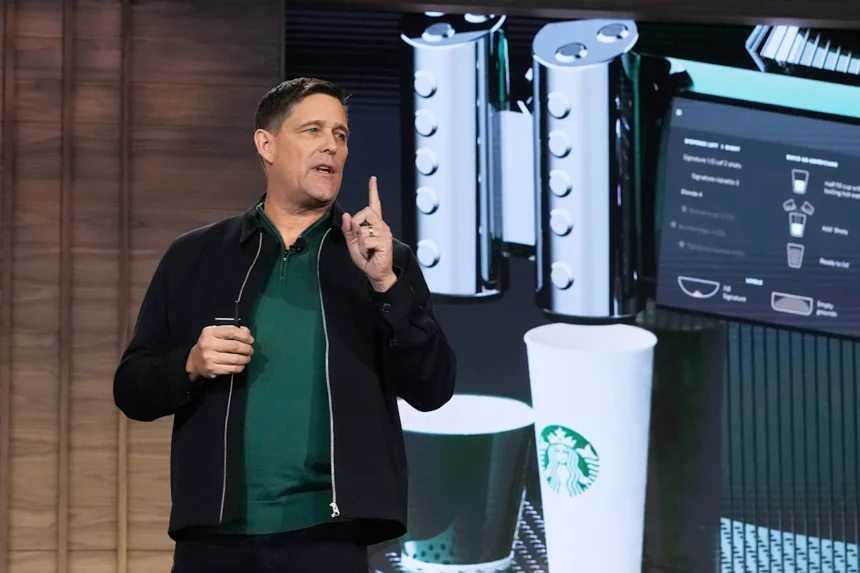
Americans are currently drinking more coffee than they have in decades, yet Starbucks, the iconic brand that transformed the U.S. coffee culture, is witnessing a decline in customer patronage amidst increasing competition. The coffee giant still reigns as the largest chain, boasting nearly 17,000 stores across the country and aspirations to launch hundreds more. However, the company’s market share has taken a hit, dropping from 52% in 2023 to 48% in 2024 and 2025, according to insights from Technomic, a food industry consulting firm.
Notably, Dunkin’ has been making significant strides, marking its presence with the opening of its 10,000th U.S. store while gaining market share during this period. Starbucks is also contending with a wave of competitors, including the rapidly expanding drive-thru chains such as 7 Brew, Scooter’s Coffee, and Dutch Bros. Other players like Chinese chains Luckin Coffee and Mixue are opening stores in the U.S., while high-end establishments like Blue Bottle are also growing, adding to the competition. Fast-food chains like McDonald’s and Taco Bell are amplifying their beverage offerings, further complicating Starbucks’ market landscape.
Experts suggest that while customer loyalty to Starbucks remains intact, consumers have opted for more diverse coffee choices. “People are now experimenting with other coffees and seeing what’s out there,” commented Chris Kayes, chair of management at the George Washington University School of Business. The National Coffee Association reported that around 66% of Americans drank coffee daily in both 2024 and 2025, a rise of 7% from 2020.
In response to growing demand, the number of chain coffee stores in the U.S. surged by 19% over the past six years, totaling more than 34,500 locations. Although Starbucks pioneered the coffee shop culture in the U.S., smaller chains are capitalizing on this trend, experiencing remarkable growth. For instance, Scooter’s Coffee has expanded from 200 locations in 2019 to over 850, while 7 Brew has grown from 14 to more than 600 during the same period.
Neil Saunders, managing director and retail analyst at GlobalData Retail, expressed that Starbucks’ expansive size may be working against it, as their capacity for growth through new store openings is diminished. “They’re a very mature business,” Saunders stated, implying that the market may be approaching saturation.
In light of these challenges, Starbucks remains optimistic. At a recent investor conference, executives highlighted efforts to enhance customer service and create inviting store environments, claiming an uptick in store traffic. The company has ambitious plans to add 25,000 seats across their U.S. cafes by this fall and aims to open over 575 new stores in the next three years. They have also developed a smaller-format store that is cost-effective while still providing indoor seating, drive-thru options, and mobile pickup services.
Starbucks is keen on introducing new products, including healthier pastries and snacks, to attract consumers who may be seeking novelty. However, competition has intensified from brands like Dutch Bros, which has adapted quickly by adding items such as protein coffee drinks long before Starbucks. Dutch Bros is also promoting convenience and value, with larger drink sizes and nearly all of its locations designed as drive-thrus with walk-up windows.
In terms of pricing, Starbucks customers are spending an average of $9.34, compared to $8.44 at Dutch Bros and $4.68 at Dunkin’, based on an analysis by investment research firm Morningstar. While the company has opted against raising prices in its 2025 fiscal year, analysts have warned against attempting to engage customers through discounts, as competitors could undercut their prices.
Starbucks’ leadership remains firm in its vision of not veering towards only drive-thru models or mobile pickup kiosks. COO Mike Grams reiterated the significance of maintaining cafes that provide a comfortable space for customers to relax while also catering to mobile, drive-thru, and delivery services. Yet, Kayes raises concerns about whether this strategy will suffice to retain Starbucks’ preeminence, suggesting that the allure of the brand may have waned amidst the proliferation of independent coffee shops and higher-end chains.
This evolving landscape leaves questions about Starbucks’ future in an increasingly competitive market where consumer choices flourish.