



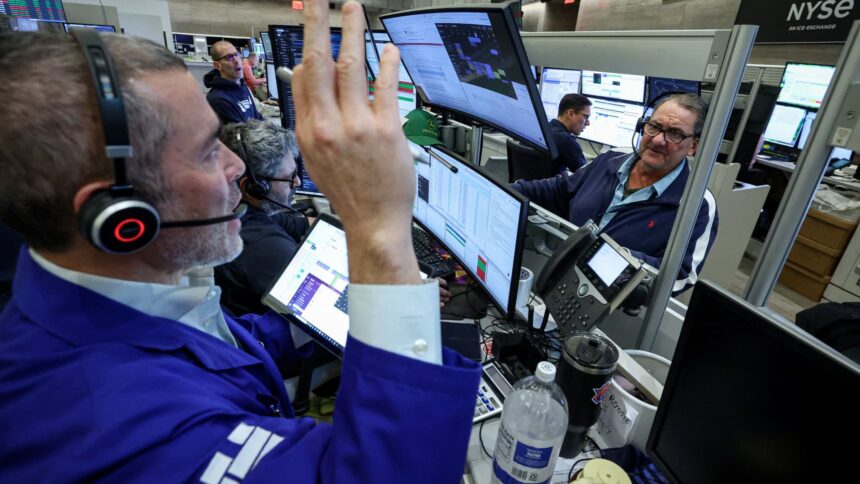
Stock futures saw a rise on Friday morning, driven by significant gains in banking and technology sectors, which contributed to an overall boost in major market indices. S&P 500 futures increased by 0.29%, while futures for the Dow Jones Industrial Average rose by 78 points, marking a 0.16% uptick. The Nasdaq 100 futures saw an advance of 0.44%.
In the previous day’s trading, major U.S. stock indexes experienced a rally. Both the S&P 500 and the Nasdaq Composite recorded nearly 0.3% gains, while the Dow added 0.6%. The small-cap Russell 2000 index was particularly strong, climbing almost 0.9%. Chip stocks emerged as standout performers after Taiwan Semiconductor Manufacturing Company (TSMC) reported exceptional fourth-quarter results, sparking renewed optimism in the artificial intelligence sector. TSMC’s stock surged over 4%, with Nvidia and AMD both seeing increases of about 2%.
Adding to the positive sentiment, the U.S. and Taiwan finalized a trade agreement that will see Taiwanese chip and tech companies commit to investing a minimum of $250 billion into production capabilities within the United States.
The financial sector also received a significant boost, particularly following robust fourth-quarter earnings announcements from Goldman Sachs and Morgan Stanley. Shares of Goldman saw a gain of more than 4%, while Morgan Stanley nearly reached a 6% increase.
Larry Adam, Chief Investment Officer at Raymond James, commented on CNBC’s “Power Lunch,” emphasizing the solid fundamentals underpinning the market, citing expected above-average earnings growth, improving margins, and anticipated interest rate cuts by the Federal Reserve later this year. However, he expressed some caution about entering 2026, warning that high valuations may expose the market to potential disappointments. Adam noted that retail investors are holding record levels of equity ownership, and the upcoming midterm elections could introduce volatility into the markets.
As investors conclude a busy week filled with a multitude of news from Washington—including increasing geopolitical tensions in Iran and Greenland, along with concerns regarding the Federal Reserve’s independence—the major indexes are projected to finish the week lower. Currently, the S&P 500 is down 0.3%, the Nasdaq has decreased by 0.6%, and the Dow has seen a slight decline of 0.1% for the week to date.