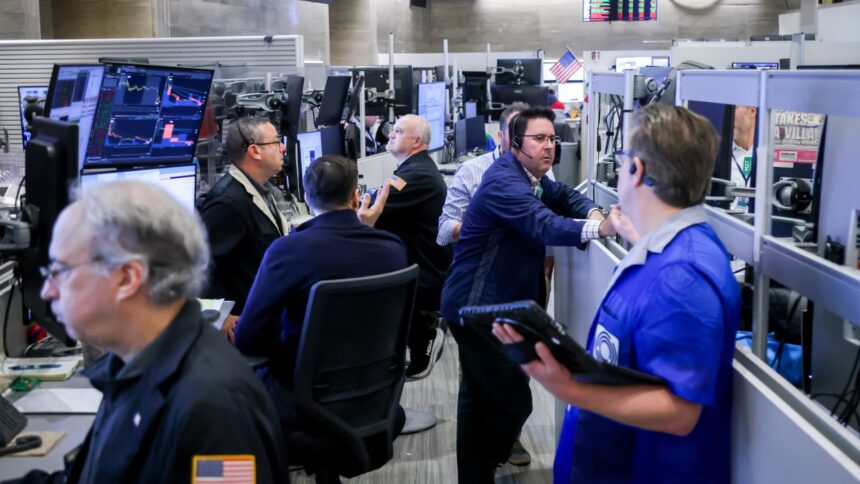
Traders on the floor of the American Stock Exchange (AMEX) at the New York Stock Exchange (NYSE) in New York experienced a notable shift in market dynamics on Thursday night, as stock futures showed little movement following a challenging day for Wall Street. Futures linked to the Dow Jones Industrial Average gained 48 points, or 0.1%, while S&P futures and Nasdaq 100 futures both saw gains of less than 0.1%.
The previous day’s trading, however, marked a significant decline, with major U.S. indexes, including the small-cap Russell 2000, suffering their worst one-day performance since October 10. The Dow dropped approximately 800 points, translating to a loss of 1.7%, effectively reversing gains made on Wednesday when it had crossed the 48,000 level.
Technology stocks faced considerable setbacks, significantly impacting the tech-heavy Nasdaq Composite, which appeared poised to end its seven-week winning streak. Prominent tech companies like Nvidia and Broadcom experienced declines of 3.6% and 4.3%, respectively, while Alphabet, the parent company of Google, fell by 2.8%.
Investor sentiment has shifted recently, with heightened concern regarding the artificial intelligence sector. The decline of Oracle, a once high-flying cloud stock, has intensified fears surrounding inflated tech valuations, an increase in debt financing, and soaring capital expenditures related to AI. Analysts pointed out that Oracle’s growth heavily relies on its partnership with OpenAI, but it operates with significantly less cash compared to its larger competitors.
Yung-Yu Ma, chief investment strategist at PNC Asset Management, reflected on the situation, stating, “We saw what happened in 2021. Those stocks got destroyed, everything was okay for a while, and then it turned out that the rest of the market had more of a reset to do as well.” He deemed the current pullback a “healthy pullback,” suggesting that while there are signs of a market reset and broken investment patterns, a recovery will be gradual.
The market tone was further influenced by ongoing concerns regarding the Federal Reserve’s approach to interest rates. Traders are now pricing in nearly a 52% likelihood that the central bank will reduce its benchmark overnight borrowing rate by a quarter percentage point in December, a decrease from the 62.9% forecast just a day earlier and a stark contrast to the 95.5% expectation a month back.
In a development that added to market uncertainty, the recent conclusion of the longest government shutdown in U.S. history raised new questions among investors. White House press secretary Karoline Leavitt indicated that some economic data expected during the shutdown might never be published. This has led some traders to believe that the Fed may be less inclined to cut rates due to the absence of crucial economic indicators.
As the trading week draws to a close, the S&P 500 has seen a modest increase of about 0.1%, the Dow has risen by 1%, while the Nasdaq has recorded a decline of nearly 0.6%. The contrasting trends within major indexes exemplify the current volatility in the market as investors grapple with a shifting economic landscape.