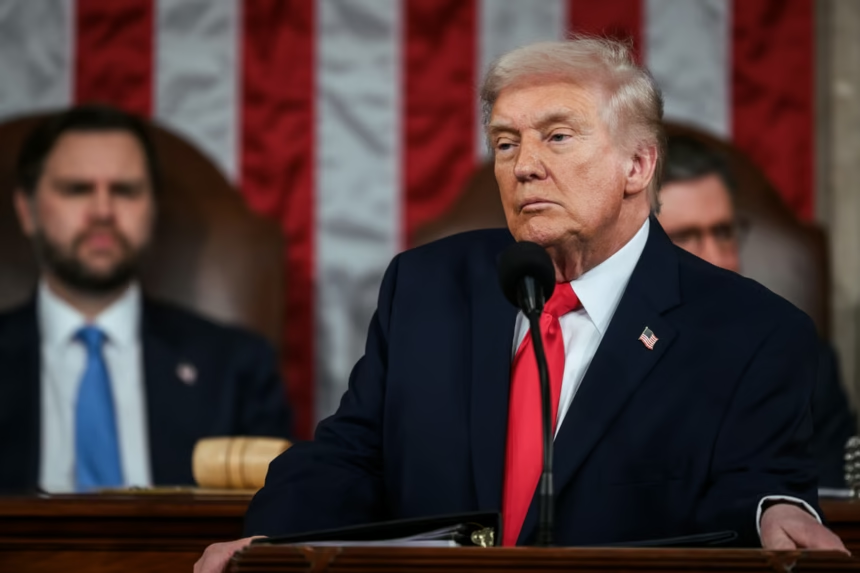
Investors have seen considerable gains during President Donald Trump’s administration, particularly in his first term, which spanned from January 20, 2017, to January 20, 2021. Key indices, including the Dow Jones Industrial Average, the S&P 500, and the Nasdaq Composite, experienced substantial increases of 57%, 70%, and an impressive 142% respectively. The stock market’s favorable conditions continued into the initial year of Trump’s second term, marked by double-digit rallies across all major stock indices.
However, recent weeks have revealed a notable trend reversal. Both the Dow and Nasdaq briefly entered correction territory, with the S&P 500 skirting a double-digit decline, prompting some investors to question the potential for a stock market crash during Trump’s presidency. This uncertainty is compounded by a significant financial catalyst that has emerged: the ongoing conflict involving Iran.
As military operations against Iran commenced on February 28, 2026, the closure of the Strait of Hormuz severely disrupted oil exports, affecting about 20% of the world’s daily liquid petroleum supply and driving crude oil prices sharply upwards. The rise in oil prices is not just impacting consumers at the pump; it carries far-reaching implications for various sectors of the U.S. economy through increased production and transportation costs.
The Federal Reserve Bank of Cleveland’s Inflation Nowcasting projection has indicated a gradual surge in the inflation rate, estimated to rise from 2.4% in February to a concerning 3.25% in March. This marks the 60th consecutive month in which inflation has surpassed the Federal Reserve’s long-term target of 2%.
Should inflation continue to climb, it may prompt a shift in policy from the Federal Reserve, which could destabilize the currently inflated stock market. Historically, the S&P 500’s Shiller Price-to-Earnings (P/E) Ratio has been above 40, a threshold previously associated with notable market downturns, including a 49% loss during the dot-com bubble and a 25% drop in the 2022 bear market. If the Fed changes its stance from rate cuts to potential rate hikes, it could set the stage for a more dramatic market correction.
While the possibility of a market downturn can evoke fear among investors, historical trends show that corrections and crashes can also present new opportunities. The current “AI Bull” market has lasted over 1,200 days, marking it as the 10th bull market to exceed 1,000 days. Comparatively, bear markets tend to be shorter, averaging around 286 days. Historical data suggests that, while volatility can linger, the stock market’s long-term trajectory typically trends upward.
In the event of a stock market crash, history indicates it could provide an ideal moment for optimistic, long-term investors to consider entering the market. The resilience of the Dow Jones Industrial Average, S&P 500, and Nasdaq Composite over time has the potential to offer promising returns for those willing to weather short-term instability.