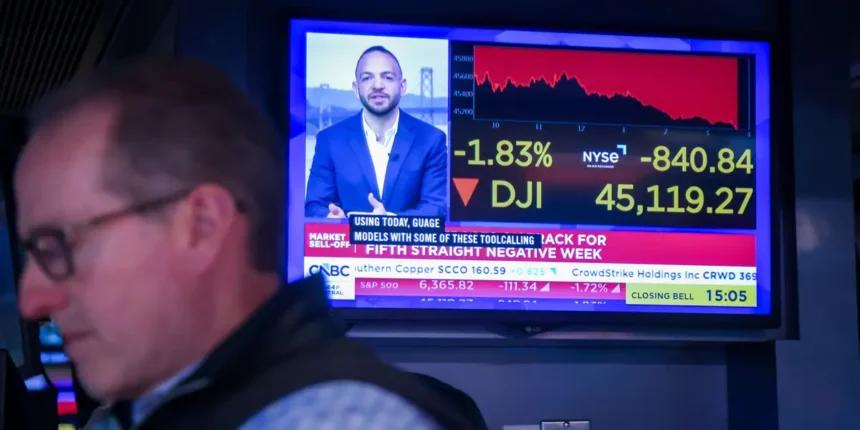
It has been a challenging week for investors, marking what some analysts suggest could be the end of the market’s reliance on presidential reassurances, notably referred to as the “Trump put.” This concept generally denotes President Donald Trump’s ability to buoy markets through his statements amid geopolitical tensions. However, investors appeared unconvinced this week, resulting in significant stock market declines as they grappled with fluctuating messages surrounding a potential peace agreement with Iran.
Despite attempts by Trump to ease tensions by delaying military action against Iran’s energy infrastructure, market sentiment remained shaky. The major indexes culminated their week with substantial losses, with Brent crude oil prices soaring to nearly $113 per barrel—its highest level since 2022. According to analysts at Barclays, the ongoing uncertainty is starting to compromise the efficacy of Trump’s remarks: “Constant flip-flopping and headline fatigue is starting to undermine the [Trump] put efficacy,” they noted, warning that continued disruptions will exacerbate stagflation concerns.
Three key milestones emerged from a tumultuous week:
-
Nasdaq 100 and Dow Enter Correction Territory: Both the Dow and Nasdaq 100 indexes crossed into correction territory—a drop of more than 10% from recent peaks. The Dow hovered on the brink of a correction throughout the day before officially falling below that threshold. Meanwhile, the Nasdaq 100 experienced this downturn earlier, particularly affected by existing pressures on technology stocks exacerbated by the ongoing conflict. Glen Smith, chief investment officer at GDS Wealth Management, remarked that tech stocks were already facing challenges before the Iran crisis, particularly concerns over high valuations and returns on AI investments.
-
Five Consecutive Weeks of Losses for the S&P 500: The S&P 500, as a broader benchmark, has now endured five weeks of losses and is teetering close to a correction from its January peak near 6,980. Analysts at BCA Research indicated that a substantial correction could prompt a strategic reassessment from Trump regarding his approach to Iran. They indicated that a decline of over 10% would significantly increase the likelihood of such a shift.
-
Oil Prices Surge to Highest Levels: Brent crude oil closed at its highest level since 2022, rising approximately 4% to nearly $112 per barrel. The increasing volatility in oil prices has set the stage for the decade to be characterized by energy shocks, with the conflict with Iran representing the most recent upheaval. Furthermore, the International Energy Agency reported that the current situation resembles major historical disruptions, citing it as one of the largest ever recorded.
While the outlook seems grim for many, there are voices of moderation. Torsten Sløk, a leading economist at Apollo, called the market overreaction into question. Having shifted from a bearish stance to a more optimistic view toward the year’s end, he believes that the current period of volatility will be short-lived, paving the way for stability and growth in the U.S. economy. Sløk contends that the economic benefits from advancements in AI, industrial growth, and significant spending initiatives will eventually outweigh the impacts of the Iran crisis.