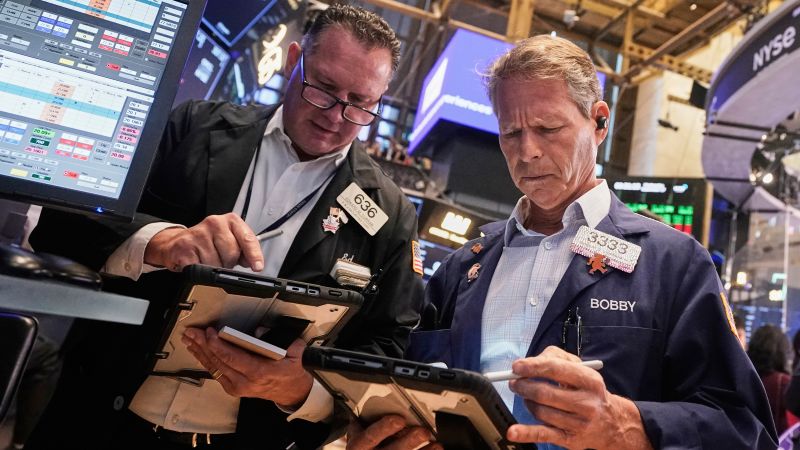
In the latest developments in the financial markets, stocks have demonstrated remarkable resilience, seemingly brushing aside concerns regarding a weakening labor market and enduring inflation. The major indices, including the Dow Jones, S&P 500, and Nasdaq, recently achieved consecutive record highs following the Federal Reserve’s first interest rate cut since December.
This year, the S&P 500 has surged 13%, defying ongoing uncertainties such as tariff disputes and apprehensions over the Trump administration’s influence on the Federal Reserve’s independence. Despite signs of economic fragility, investor sentiment remains optimistic, largely due to the anticipated continuation of a rate-cutting cycle. Analysts caution that the market may be increasingly divorced from economic realities, a sentiment echoed by the emergence of worries surrounding a potential “K-shaped economy.” Nevertheless, corporate profits have generally exceeded Wall Street’s expectations, with approximately 81% of S&P 500 companies posting earnings per share that surpassed predictions.
Larry White, an economics professor at NYU Stern, noted that as long as there is no evidence of significant harm to corporate profits, the bullish trend in stocks is likely to persist. He remarked, “Everyone I know is concerned, but we’re not the markets. The markets are just clearly optimistic.” Interest rate reductions can lower savings rates and borrowing costs, which generally stimulates consumer spending and business investment—factors that can create a favorable environment for stock performance.
The Federal Reserve’s recent dot plot, which outlines expected future interest rate changes, indicated two additional rate cuts this year, aligning with Wall Street’s projections. Financial analysts, including José Torres from Interactive Brokers, observed that the stock market showed no signs of slowing down after the Fed’s announcement, predicting further cuts by the holiday season.
Additionally, the Russell 2000 index, which tracks smaller companies, marked its first record high since 2021, having climbed 40% since its lowest point in April. This surge reflects a growing optimism among smaller businesses about the prospects of lower interest rates and a more conducive market.
Seema Shah, Chief Global Strategist at Principal Asset Management, expressed a generally positive outlook for equities, acknowledging that while the economy is showing signs of a slowdown, the Federal Reserve appears capable of managing labor market concerns. “There’s a sense of comfort and confidence that they can arrest the (labor market) slowdown before it gets away from them,” Shah stated.
Historical data suggests that since 1980, when the Fed has reduced rates while the S&P 500 is near all-time highs, the index has generally risen over the following twelve months. Keith Lerner, co-chief investment officer at Truist Advisory Services, emphasized the continued importance of corporate profits, which will be crucial to monitor going forward.
Despite these optimistic trends, uncertainty remains a constant in the financial landscape. Federal Reserve Chair Jerome Powell underscored the importance of being data-driven, while also expressing concerns over persistent inflation. He acknowledged that there is “no risk-free path” ahead for the central bank.
Bank of America recently upgraded its profitability growth forecast for the S&P 500. However, strategists highlighted risks such as the effects of tariffs on inflation and the potential slowdown in consumer spending due to labor market weaknesses. Savita Subramanian, an equity strategist at the bank, remarked that while companies have managed Trump’s tariffs without significant margin losses, the full impact may still be forthcoming.
Furthermore, analysts are voicing concerns about the historically high valuations of stocks. In a recent survey, 58% of global fund managers indicated that they view stock markets as overvalued, creating a noted disconnect between market performance and underlying economic conditions. David Kelly from JPMorgan Asset Management articulated that while the stock rally might continue until a significant economic shock occurs, investors should remain cautious in light of current valuations and consider portfolio rebalancing strategies.