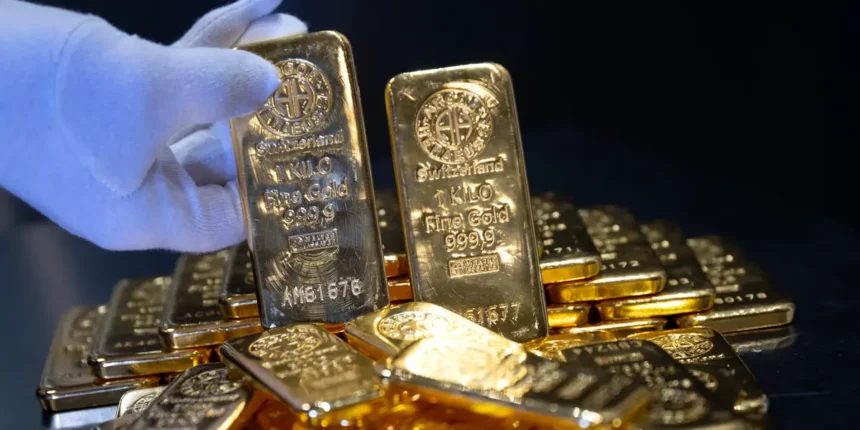
The stock market is currently signaling potential challenges for investors, primarily driven by a noticeable shift in the dynamics between the S&P 500 and gold prices. According to strategists at Stifel, the surge in gold, which has risen over 20% in 2026 so far, starkly contrasts with the S&P 500’s modest gain of only 1% during the same period. This divergence indicates a breakdown in a historic correlation where typically, movements in the stock index and gold prices align more closely.
Stifel highlighted that the relative price of the S&P 500 to gold has dropped below its seven-year moving average, a key indicator that has historically suggested difficulties ahead for stocks. In the firm’s analysis, instances of this relationship falling below the moving average have been rare, occurring only four times in the last century, with the most recent occurrence over 20 years ago, coinciding with the burst of the dot-com bubble.
The strategists emphasized that when this relationship has faltered, stocks have often struggled, remaining in a narrow trading range without significant upward movement. They noted that the systemic breakdown between stocks and gold typically foreshadows economic challenges, including a lack of productivity and prolonged low-inflation growth.
In a note from the firm, Barry Bannister, a managing director at Stifel, remarked on the decisive breakdown of the S&P 500 against gold, suggesting that while there’s a possibility that both could continue to rise, this scenario aligns with a broader retreat from traditional fiat currencies—an outcome that historical precedents indicate is fraught with risk.
Stifel’s analysis posits that the S&P 500 may consolidate around the key psychological level of 7,000, a threshold that the index briefly surpassed earlier. They support this view with both their assessment of the Equity Risk Premium and valuation metrics related to the benchmark index.
Despite some optimistic forecasts on Wall Street for continued growth in 2026, concerns remain regarding geopolitical tensions and the sustainability of recent AI-driven market trends. Stifel has approached the outlook with caution, projecting a potential upside of up to 9% for the S&P 500 this year, but also issuing a stark warning that the index could decline by as much as 20% should the U.S. enter a recession. Investors are advised to keep a close eye on market signals as conditions evolve.