










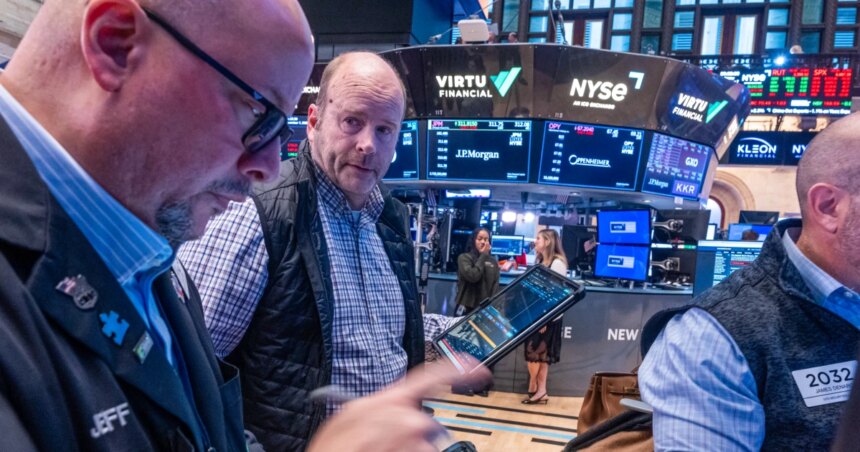
Stocks experienced their first weekly losses in three weeks, with investor concerns about the inflated valuations of artificial intelligence companies leading to a market pullback. The Nasdaq Composite, which focuses on major technology firms, fell by 3% over the week, marking its worst performance since April 2023, amid significant market fluctuations triggered by President Donald Trump’s tariff policies. Meanwhile, the S&P 500 saw a decline of 1.6%, breaking its streak of three consecutive weekly gains.
Despite a day of mixed performance, stocks rallied from earlier lows after Senate Democrats proposed a new plan to resolve the ongoing government shutdown. The Dow Jones Industrial Average and the S&P 500 ended the day slightly positive, while the Nasdaq closed lower.
Year-to-date, both the Nasdaq and S&P 500 maintain robust double-digit gains, although recent market pressures can be largely traced to firms associated with the artificial intelligence surge. Collectively, major players such as Microsoft, Nvidia, AMD, Palantir, Oracle, and Meta Platforms have seen over $820 billion wiped from their market values this week alone. Nvidia’s shares dropped 7%, while Oracle and AMD each experienced declines of 8.8%. Both Meta and Microsoft saw approximately 4% reductions in their stock prices.
Super Micro Computer, which provides servers and equipment for cloud computing applications in AI, was the worst performer among S&P 500 stocks, plummeting by 23% over the week. Overall, the technology sector within the S&P 500 was notably weak, declining by 4.2%.
However, not all tech stocks faced significant losses. Apple and Alphabet both concluded the week with only minor declines of about 0.7%, while Amazon managed to secure a small gain.
The sell-off initiated on Tuesday following disappointing earnings from Palantir, a government contractor and AI developer, raising concerns about its valuation. Market sentiment was further influenced by remarks from top Wall Street executives suggesting an impending market correction. Nvidia CEO Jensen Huang exacerbated these worries when he stated that China would likely surpass the U.S. in AI development, a statement he later softened, claiming the two nations were closely matched in technological advancement. In contrast, President Trump expressed confidence, stating he was not worried about an “AI bubble” and underscoring America’s leadership in the field.
Adding to the market’s woes, consumer sentiment, as reported by the University of Michigan’s survey, plummeted to near-record lows. “With the federal government shutdown dragging on for over a month, consumers are now expressing worries about potential negative consequences for the economy,” said survey director Joanne Hsu.
The ongoing government shutdown has also hindered the availability of official economic data, leading to heightened uncertainty in the market. Essential reports, including the jobs report initially scheduled for release on Friday, were postponed. The extended shutdown has pushed investors to rely more on corporate earnings and alternative indicators, such as a private employment report from ADP, which showed that only 42,000 jobs were added last month. Additionally, a report from Challenger, Gray & Christmas noted that announced job cuts from U.S. employers reached the highest level for October in 22 years, further stressing the economic outlook.


