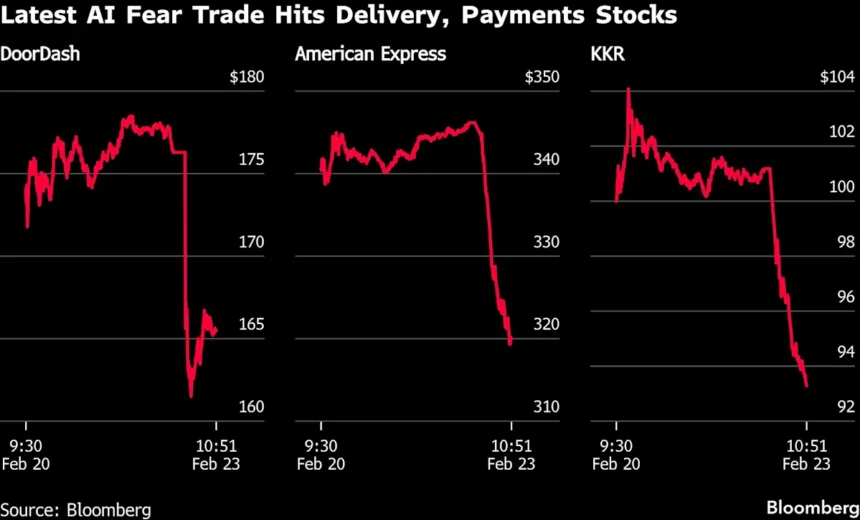
Delivery, payments, and software stocks experienced a significant decline Monday following the publication of a report by Citrini Research. The study outlined potential risks that artificial intelligence poses to various sectors of the global economy, leading to substantial drops in share prices for several high-profile companies.
DoorDash Inc., American Express Co., KKR & Co. Inc., and Blackstone Inc. each saw their stocks fall by more than 8%. Other companies mentioned in the report, such as Uber Technologies Inc., Mastercard Inc., Visa Inc., Capital One Financial Corp., and Apollo Global Management Inc., also faced declines of at least 3%.
Citrini Research, which was founded by James van Geelen, released the report with a preface noting its intention to outline a scenario that has not been widely explored. The document presents a hypothetical situation set in June 2028 where AI disruption leads to mass unemployment among white-collar workers, reduced consumer spending, increased defaults on software-backed loans, and overall economic contraction. The report explicitly states, “What follows is a scenario, not a prediction.”
Among the various outcomes discussed, the report suggests that the dominance of popular delivery services like DoorDash and Uber Eats could be challenged by emerging alternatives described as “vibe-coded.” Responding to the report, DoorDash co-founder Andy Fang acknowledged the shifts suggested by the report, stating that the industry must adapt to a changing landscape.
The report further explores a future where AI agents work to save users money by removing transaction fees charged by payment processors such as Mastercard and Visa. It emphasizes that while some dire scenarios may not materialize, investors should evaluate how much of their portfolios rely on assumptions that may not hold true in the coming years.
The grim projections outlined in the report added to existing anxieties in a stock market that has faced volatility in recent weeks due to concerns over AI disruption and geopolitical issues. Portfolio manager Thomas George from Grizzle Investment Management expressed that the report raises valid concerns about potential disruptions. He noted that reading the document could leave investors with lingering doubts about their confidence in affected stocks.
In recent weeks, sectors ranging from software and wealth management to logistics have been caught in a wave of sell-offs as investors wary of potential AI-related disruptions have adopted a “shoot first, ask questions later” mentality. Software companies have been particularly impacted, although other sectors—including insurance brokers, private credit firms, cybersecurity, and real estate services—have also been swept up in what is being termed the “AI scare trade.”
Despite the turmoil, some analysts and strategists caution that reactions to the report may be exaggerated and could be overestimating the immediate risks associated with AI technology. Michael O’Rourke, chief market strategist at Jonestrading, remarked on the remarkable nature of the market’s response, noting the resilience it has shown in the face of actual negative news as compared to the market’s reaction to a speculative report.
As investors navigate through these discussions, uncertainty looms over how emerging technologies like AI could reshape industries and the economy in the years to come.