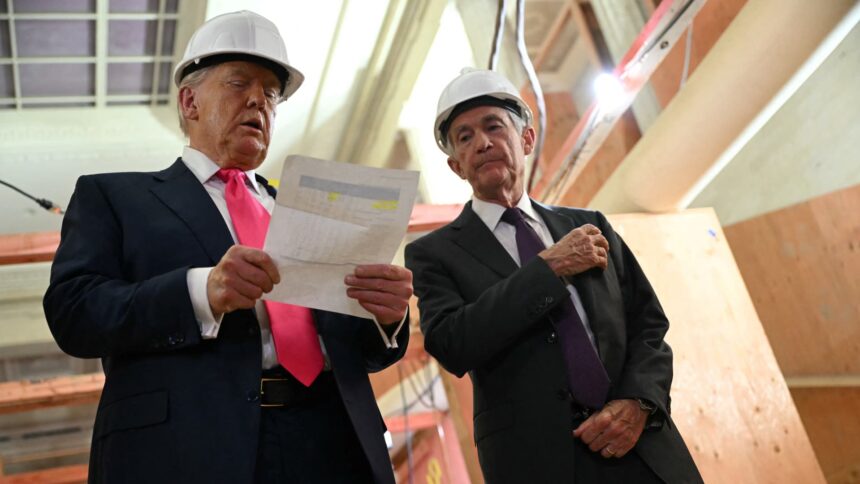
Stock investors seemed largely unfazed by the revelation of a criminal investigation into Federal Reserve Chair Jerome Powell, marking another instance of the market downplaying political risk. Initially, on Monday, the Dow Jones Industrial Average saw a significant drop, falling nearly 500 points as concerns mounted that the probe signaled a broader initiative by President Donald Trump to undermine the Federal Reserve’s independence in managing interest rates.
However, as the trading day progressed, both the Dow and other major indices—including the S&P 500 and the small-cap focused Russell 2000—managed to recover, ending the session at all-time highs. This unexpected rebound contrasts with the typical market behavior that associates political turmoil with immediate stock declines as traders seek to mitigate risk.
Market analysts speculated whether the investigation into Powell would reignite fears related to a “Sell America” sentiment, implying a higher risk premium for U.S. financial assets. Notably, however, strong support for Powell from prominent economists around the world, combined with opposition from certain Republican figures in Washington, appeared to ease investor concerns, suggesting that the situation might be a transient conflict rather than a fundamental threat to the Fed’s autonomy.
Several economists reiterated Powell’s perspective, arguing that the investigation was more about interest rates stalling rather than about undermining the Federal Reserve. Former Fed Chair Janet Yellen expressed her surprise that the market did not appear more distressed by the news.
As the day unfolded, it became increasingly apparent that opposition to the investigation was coalescing among Republicans. Senator Thom Tillis of North Carolina indicated he would oppose any of Trump’s nominees for the Fed amidst the ongoing scrutiny, potentially reassuring traders that the conflict would not escalate beyond its current state.
Despite the positive performance of U.S. stocks, other asset classes reflected a heightened sense of caution among investors. The U.S. dollar weakened against other currencies, while safe-haven assets like gold and silver reached new highs. Additionally, U.S. equities lagged behind international markets, indicating a slight underperformance compared to a global benchmark.
The CBOE Volatility Index (VIX), often referred to as Wall Street’s fear gauge, experienced a spike throughout Monday. Nevertheless, it remained within its recent trading range, a situation that led market participants like Siebert Financial’s Chief Investment Officer Mark Malek to conclude that investor worry levels were still manageable.
“Investors expect all this to blow over, or they simply don’t want to focus on this as we enter Q4 earnings season,” Malek noted. As market participants turned their attention to upcoming inflation data and corporate earnings reports, it was evident that the potential fallout from Powell’s investigation might not derail broader market sentiment after all.