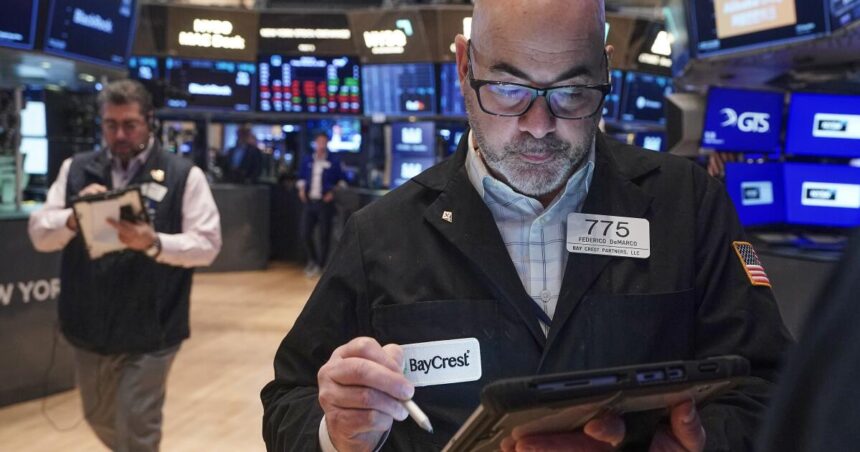
Stocks showed signs of stability on Friday following a positive inflation report that alleviated concerns on Wall Street. The Standard & Poor’s 500 index experienced minimal movement, particularly after enduring one of its most significant declines since Thanksgiving just a day prior. The Dow Jones industrial average managed to gain 48 points, or 0.1%, while the Nasdaq composite experienced a slight decrease of 0.2%.
The easing of Treasury yields provided additional support to the stock market, prompted by a report indicating that inflation had slowed more than anticipated last month. U.S. consumers faced price increases of 2.4% year-over-year in groceries, clothing, and general costs of living— a rate that, while still higher than the Federal Reserve’s 2% target, marked a decrease from December’s 2.7%.
Economists noted that a key underlying measure of inflation, which is often viewed as a better indicator for future trends, had dropped to its lowest level in nearly five years. Brian Jacobsen, chief economic strategist at Annex Wealth Management, remarked, “It’s still too high, but only for now, not forever.” The ongoing deceleration of inflation could potentially allow the Federal Reserve more flexibility in cutting interest rates if necessary. The Fed’s rate cuts have been on hold, yet analysts widely expect a resumption in the later part of this year. Such cuts could stimulate the economy and positively impact stock prices, though they pose the risk of fueling inflation.
In broader economic terms, the outlook appears improved compared to the end of 2025. In addition to the slowdown in inflation, the job market showed unexpected growth last month. On Wall Street, stocks steadied for some companies perceived as susceptible to disruptions from artificial intelligence (AI). For instance, AppLovin faced a nearly 20% decline on Thursday despite surpassing profit expectations. Concerns lingered over AI-driven competitors potentially displacing traditional software firms.
However, AppLovin rebounded with a 6.4% increase on Friday. Similarly, trucking and freight companies, which suffered significant losses after claims from Algorhythm Holdings about their AI capabilities, also saw a turnaround. C.H. Robinson Worldwide, after a 14.5% drop on Thursday, gained 4.9% the next day.
The skeptical sentiment toward industries at risk of AI disruption has prompted swift market reactions, sparking comparisons to a “shoot first, ask questions later” mentality among investors. Applied Materials emerged as a strong performer on the S&P 500, surging by 8.1% after reporting quarterly profits exceeding analyst expectations, with CEO Gary Dickerson attributing growth to increased industry investment in AI computing.
On the other hand, DraftKings faced a stark 13.5% drop despite exceeding profit expectations; its revenue forecast for the year did not meet market predictions. Norwegian Cruise Line Holdings also fell 7.6% following the abrupt replacement of its CEO weeks before a planned quarterly earnings report.
Nvidia, being the largest stock on Wall Street, also weighed heavily on the market, with a 2.2% dip impacting the S&P 500 due to its significant market influence.
In closing, the S&P 500 increased by 3.41 points, finishing at 6,836.17, wrapping up its weakest week since November. The Dow Jones industrial average rose 48.95 points to 49,500.93, while the Nasdaq composite fell by 50.48 points to rest at 22,546.67.
In the bond market, the yield on the 10-year Treasury fell from 4.09% to 4.05%, while the yield on the two-year Treasury, which closely aligns with Fed action expectations, dropped to 3.40% from 3.47%. Across international markets, indexes reflected a mixed bag; Asia saw declines, particularly with Hong Kong’s Hang Seng dropping 1.7% and Japan’s Nikkei 225 losing 1.2%.