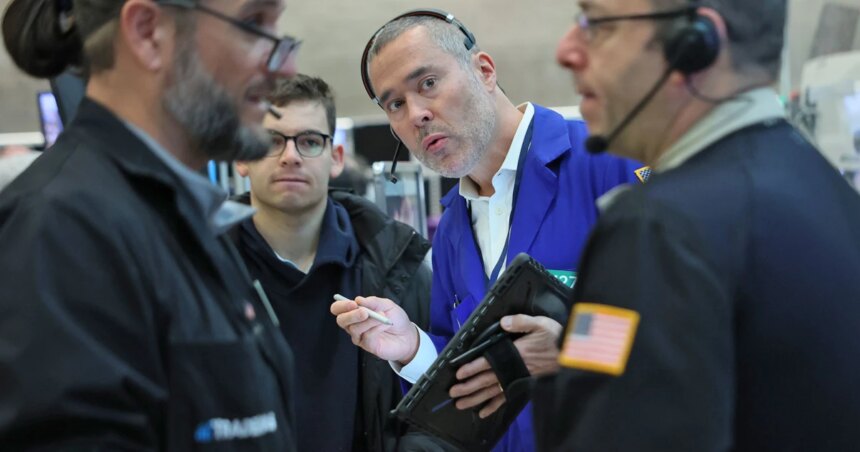
Stocks have experienced significant fluctuations recently as investor sentiment shifts regarding the potential impact of artificial intelligence on various industries. Initially driven by enthusiasm surrounding AI technology, which propelled many stocks to record highs, recent concerns over excessive investments in AI have prompted investors to reassess the sustainability of these gains.
On a tumultuous Monday, major companies linked to AI, such as Visa, Mastercard, and IBM, saw their shares drop sharply. This sell-off was part of a broader trend reflecting anxieties about the viability of AI-related business models, particularly after a warning from Citrini Research. Their post forecasted a potential market crash, a decline in consumer spending, and extensive layoffs by 2028, all attributed to advances in AI technology. Payment processors, in particular, felt the repercussions, with traders contemplating a future that includes decreased consumer expenditures.
Notably, IBM experienced its steepest one-day decline since the dot-com bubble burst in 2000, exacerbated by Anthropic’s announcement that its Claude Code tool could modernize legacy coding languages traditionally associated with IBM’s services. Investors perceived this as a threat to IBM’s core business, which involves maintaining and modernizing older systems. The fallout was felt not just at IBM but also had a ripple effect across the tech sector, leading to declines in shares of consulting firms like Accenture and Cognizant Technology.
The overall market’s response was swift, with all three major indices declining; the Dow Jones Industrial Average alone fell over 800 points. Five of the eleven sectors within the S&P 500 closed down, with financials and consumer discretionary sectors suffering the most significant losses.
Mona Mahajan, head of investment strategy at Edward Jones, remarked on the rapid withdrawal of investments from sectors perceived as threatened by AI, including financial services and logistics. Despite the volatility in stock prices, she emphasized that the fundamental business operations of many companies remain unchanged, indicating that the market reactions could be premature or speculative in nature.
Amid the sell-off, the consumer staples sector emerged as a safe haven for investors, with companies like Walmart and Coca-Cola attracting capital as they are viewed as less susceptible to disruption from AI advancements. Companies not deeply affected by the transformative potential of AI saw a stabilizing effect on their stock prices.
As the landscape continues to evolve, the implications of AI surpass mere technological advancements. Melissa Otto from S&P Global highlighted that increased investment in AI could disrupt existing business models across various sectors. She noted that organizations with intricate workflows and proprietary data are more likely to thrive amidst the challenges posed by AI, as they could leverage their unique assets for competitive advantage.
On top of the AI-related concerns, additional factors, including geopolitical tensions and legal uncertainties surrounding President Trump’s tariffs, contribute to a complex market environment. Nevertheless, some analysts like Lori Calvasina from RBC Capital Markets suggest that discussions around AI might distract investors from equally pressing issues affecting various sectors. She encourages a broader examination of the market landscape, away from the existential fears of industries like wealth management and transportation.
As investors navigate this volatile terrain, the future remains uncertain, underscoring the profound and far-reaching implications of AI on the economy and individual companies.