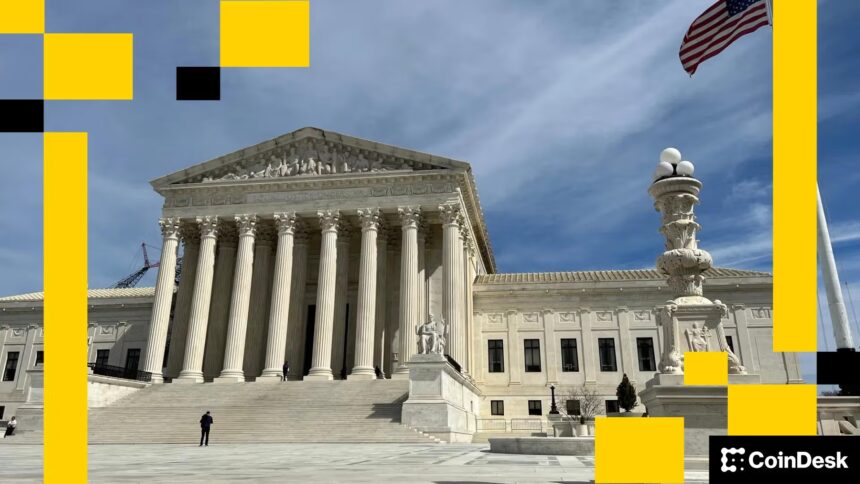
The U.S. Supreme Court has delivered a significant ruling, declaring that former President Donald Trump’s imposition of tariffs was beyond his legal authority. While financial markets have reacted to this decision with relative calm, experts anticipate that the repercussions for the cryptocurrency sector may be limited in the short term. Political factors could play a crucial role in shaping future policies affecting the industry in Washington.
Trump’s aggressive tariff strategy, executed under the International Emergency Economic Powers Act (IEEPA), has now been halted. However, the former president indicated on Friday that he still possesses several alternative avenues for implementing tariffs. Following the Supreme Court’s “deeply disappointing” decision, Trump vowed to explore these other legal frameworks for tariffs, describing them as possibly even more effective than the IEEPA measures. During a press conference, he announced plans for a new 10% global tariff.
The next few weeks will be critical as policymakers focus on various issues, potentially diverting attention from the urgent need to advance the Digital Asset Market Clarity Act—an important legislative goal for the cryptocurrency industry. The Act aims to establish a clear regulatory framework for the crypto market in the U.S.
Senator Bernie Moreno, a Republican from Ohio and strong Trump ally, expressed frustration over the ruling, terming it “outrageous” and detrimental to American workers who have suffered from unfair trade practices. Meanwhile, Senator Elizabeth Warren, a leading Democrat on the Senate Banking Committee, welcomed the Supreme Court’s 6-3 decision, but noted that it did not address the harm already inflicted on consumers, estimating that households faced a financial burden of $1,000 last year and $1,300 this year due to tariffs.
Warren highlighted the limitations faced by consumers and small businesses in obtaining refunds for the excess costs attributed to the tariffs, while large corporations may benefit from a legal mechanism for recouping those expenses. This sentiment was echoed by the Cato Institute, which pointed out the potential for refunds on billions of dollars collected through tariffs. However, they cautioned that the process for such refunds might involve extensive litigation, placing a heavier burden on smaller importers.
The fallout from the tariff dispute is expected to take center stage in the midterm congressional elections. As lawmakers campaign, they will likely emphasize the direct impact of tariffs on ordinary Americans, as Warren suggested. The outcome of these elections could significantly influence the direction of cryptocurrency legislation, depending on whether Democrats manage to secure a majority in either the House of Representatives or both chambers of Congress. Even if the Digital Asset Market Clarity Act is passed by summer, additional legislative factors concerning taxation and bitcoin reserves could still pose challenges.
The Supreme Court’s rejection of Trump’s tariff approach may inadvertently offer momentum to Democratic candidates, who could leverage the implications of the ruling in electoral contests. Should Democrats gain control of the House, they may impose more rigorous revisions on current crypto policy initiatives, potentially complicating efforts to advance the sector without significant alterations.