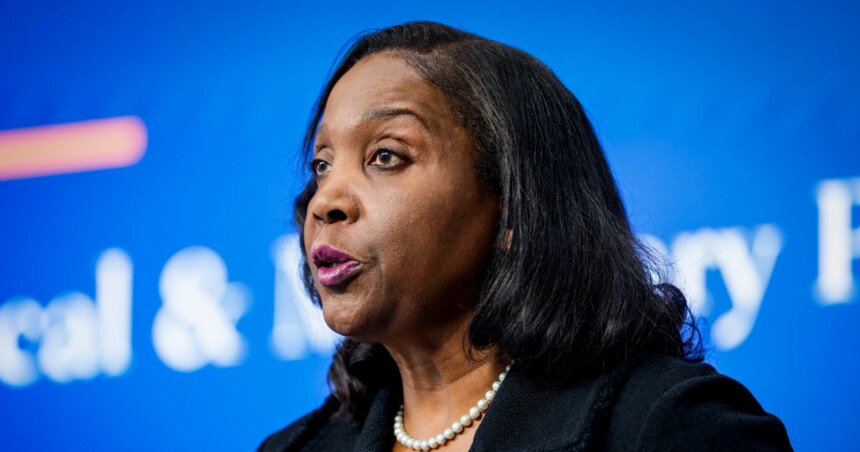
In a pivotal case with significant implications for both the economy and the structure of government, the Supreme Court is set to hear arguments regarding President Donald Trump’s efforts to dismiss Federal Reserve board member Lisa Cook. This legal battle arises as Trump seeks to extend his influence over the Federal Reserve, which plays a crucial role in setting interest rates and managing monetary policy.
The case has gained further urgency amid reports that the Justice Department is conducting an investigation into Federal Reserve Chair Jerome Powell. Established by Congress to operate independently, the Federal Reserve is designed to shield its decisions from political pressures, aiming to maintain both price stability and low unemployment.
According to the Federal Reserve Act, a sitting governor can only be removed “for cause,” which implies the presence of wrongdoing. Trump has asserted that he intends to fire Cook based on allegations of mortgage fraud levied by Bill Pulte, a political appointee in the Federal Housing Finance Agency. However, Cook has firmly denied these allegations, and documentation obtained by NBC News seemingly contradicts Pulte’s fraud claims.
In an earlier ruling, the Supreme Court declined to permit Trump to proceed with dismissing Cook immediately, instead opting to schedule oral arguments. This decision suggests that Trump’s legal team may face an uphill challenge in asserting that the removal cannot be subjected to judicial review. Cook’s legal representatives argue that she should be afforded the opportunity to contest Trump’s reasons for her dismissal before any final decision is made, particularly claiming that the rationale doesn’t rise to the statutory requirement for a “for cause” termination.
The Trump administration is represented by Solicitor General D. John Sauer, who contends that Cook has no entitlement to a hearing on her removal. Instead, he asserts that the decision is solely within the jurisdiction of the president, emphasizing the powers granted under Section 2 of the Constitution.
Jerome Powell, the current Federal Reserve Chair, is anticipated to attend the oral arguments. Since taking office, Trump has consistently criticized Powell and the Federal Reserve for not implementing more aggressive interest rate cuts, despite having appointed Powell to his position in 2017. While Trump has refrained from attempting to remove Powell, the ongoing Justice Department inquiry into his congressional testimony about Fed refurbishments raises concerns that this could be used as justification for dismissal, should there be a desire to do so. Powell’s term as chair ends in May 2022, but he could continue serving on the board until 2028. Conversely, Cook’s term, appointed by President Joe Biden, extends through 2038.
The Trump administration’s maneuvers involving Cook and Powell have sparked anxiety among former Federal Reserve officials and critics, who highlight the necessity of the Fed’s independence for its effectiveness. Concerns are being voiced over potential White House control over the central bank’s decision-making processes. Senator Elizabeth Warren (D-Mass.) described the situation as unprecedented, warning that Trump is attempting to commandeer the central bank to further his political agenda and cater to wealthy allies. While Warren has criticized certain Federal Reserve policies, she maintains that its decisions should be based on empirical data and not political motivations.
Economists caution that short-term interest rate reductions aimed at fulfilling Trump’s objectives could yield detrimental long-term outcomes. Former Federal Reserve chairs, along with other high-ranking officials, issued a joint statement denouncing approaches that are reminiscent of monetary policymaking in emerging markets characterized by fragile institutions, noting that this can lead to adverse effects on inflation and overall economic performance.
Since assuming his second term, Trump has been engaged in efforts to assert control over several independent agencies established by Congress, prompting concerns about political overreach. While previous Supreme Court decisions have permitted such firings, a May ruling implied that the Federal Reserve may be treated differently due to its unique and quasi-private structure, suggesting more stringent standards for its governance.