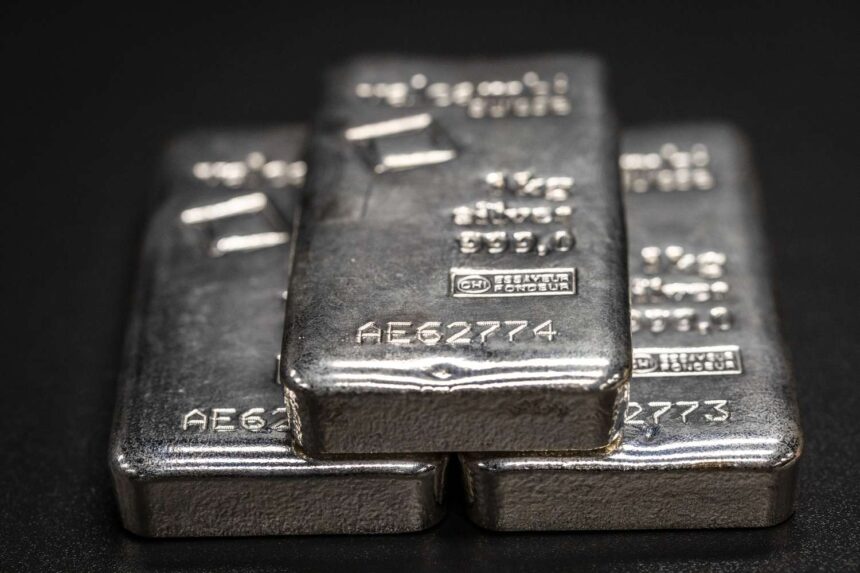
In 2025, the precious metals market is experiencing a significant surge, driven by a complex blend of economic uncertainties and shifting investment dynamics. While gold remains a focal point, silver and platinum have notably outperformed, with silver recently closing September at a historic high and platinum achieving remarkable price increases as well.
This year, gold prices have been on a remarkable trajectory, set to achieve their highest annual return in nearly 50 years. Currently trading around $3,900 per troy ounce, gold has reached multiple all-time highs, reflecting a staggering increase of nearly 10% over the past month amidst surrounding concerns of a U.S. government shutdown. Gold’s ascent has far surpassed the S&P 500 Index, which has posted a 14% gain this year, positioning gold for its best performance since 1979, when it more than doubled due to rampant inflation.
Silver has also demonstrated exceptional growth, securing a year-to-date return of about 65% and hovering near $48 per troy ounce—breaking past a previous peak of $43 set in 2011. In contrast, platinum has exhibited even more impressive gains, with a nearly 80% year-to-date increase, now trading around $1,600 per troy ounce. This robust performance has benefited mining companies as well, illustrated by the Van Eck Gold Miners ETF (GDX) and the Global X Silver Miners ETF (SIL), both of which have surged about 125%.
The underlying demand for these precious metals stems not only from traditional investment motivations but also from their roles in industrial applications. While approximately 90% of gold demand is driven by investors, central banks, and jewelry, silver and platinum enjoy diverse industrial uses that enhance their attractiveness. Silver is pivotal in electronics and circuitry, while platinum is essential for automotive catalytic converters and various chemical processes.
Furthermore, current global economic conditions—characterized by inflation, trade policy uncertainties, and speculation regarding shifts in U.S. monetary policy—are propelling precious metal investments. The Federal Reserve’s potential interest rate cuts may further diminish the attractiveness of yield-generating assets, reinforcing precious metals as safe havens.
The World Gold Council recently highlighted the precarious financial landscape, suggesting that rising inflation alongside economic stagnation and weakening labor markets raises concerns of stagflation. This prevailing uncertainty is expected to sustain demand for precious metals for the foreseeable future, positioning them as vital components of diversified investment strategies amidst volatile market conditions. As analysts eye potential further upside for these assets, the precious metals market remains a focal point for both individual investors and institutional players navigating today’s economic challenges.