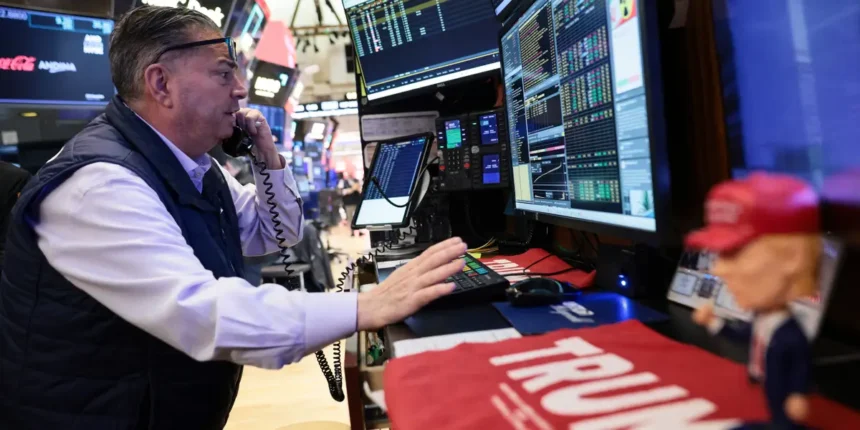
This week, investors experienced significant market fluctuations, primarily driven by the announcement of a ceasefire agreement with Iran, which alleviated fears regarding rising oil prices and potential economic downturns. The ceasefire has been viewed as a relief from one of the most significant worries facing investors—an extended conflict that could exacerbate inflation and threaten to push the U.S. economy into recession.
In the wake of this development, stock markets demonstrated remarkable resilience, with U.S. stocks experiencing considerable increases. The Dow Jones Industrial Average soared by over 1,300 points on Wednesday, showcasing the positive sentiment. Overall, the S&P 500 recorded a rise of more than 2%, while the Nasdaq surged nearly 3%. By week’s end, the S&P 500 achieved a notable weekly gain of 3.6%, marking its largest increase since November.
Conversely, oil prices witnessed a sharp decline, as Brent crude and U.S. oil fell below the $100-per-barrel mark. This decrease is considered significant, with Brent closing the week at $94.50 per barrel and U.S. West Texas Intermediate (WTI) finishing at $95.98. Wednesday’s trading session was particularly dramatic, as WTI experienced its largest single-day drop since 2020, while Brent recorded its most considerable weekly decrease since 2022.
In addition to the stock market and oil prices, Treasury yields also dropped. The yield on the 10-year U.S. Treasury fell from 4.34% on Tuesday to a low of 4.24% on Wednesday, eventually stabilizing around 4.31% by the end of the week. This decline in yields reflects a shifting investor perspective on future inflation and interest rate expectations. With the ceasefire in place, there are hopes that maritime traffic through the critical Strait of Hormuz may begin to normalize, potentially mitigating the risk of a sustained energy crisis.
The market’s reaction to these developments significantly influenced expectations regarding Federal Reserve policy, with the likelihood of a rate cut at least once by 2026 increasing to about 30%. As investors recalibrate their strategies in light of the evolving geopolitical landscape, the week underscored the interconnectedness of global events and their immediate impact on financial markets.