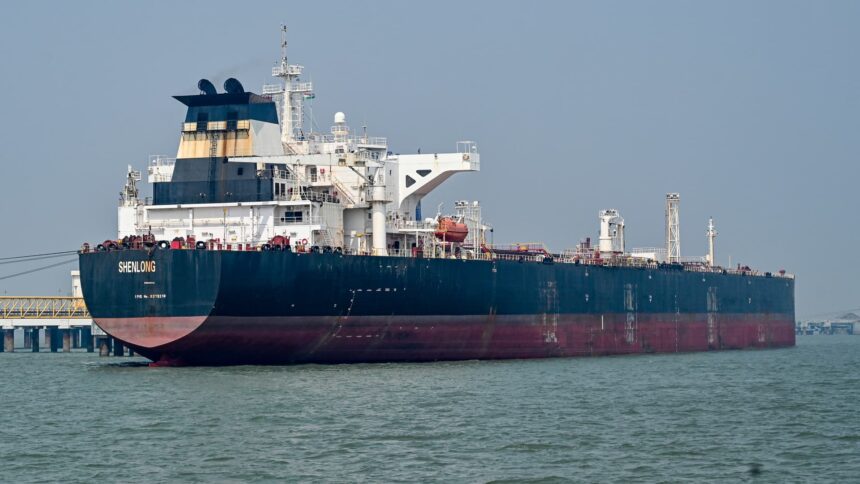
The Liberia-flagged crude oil tanker Shenlong Suezmax has successfully docked at Mumbai Port after navigating the volatile Strait of Hormuz amidst the escalating conflict in West Asia. This event occurred on March 11, 2026, highlighting the precarious situation in the region as oil prices continue to soar.
In the wake of the escalating tensions, oil prices reacted sharply. U.S. West Texas Intermediate crude futures for May surged by 5.9%, reaching $106.02 a barrel, while June futures for the international benchmark Brent crude jumped 6.5%, reaching $107.78 per barrel. The increase was largely attributed to remarks from U.S. President Donald Trump, who indicated in a national address the possibility of further military action against Iran in the coming weeks. He characterized the rise in oil prices as a direct consequence of “deranged terror attacks” launched by Iran against commercial oil tankers and neighboring nations.
During the address, Trump stated that the U.S. would “hit” Iran “extremely hard,” asserting that while discussions with Tehran were ongoing, the military campaign would be quick and decisive. “We are going to finish the job, and we’re going to finish it very fast,” he declared, a statement that suggests a commitment to maintain or intensify military pressure.
Market analysts are sensing a growing risk-off sentiment among investors. Brent George Efstathopoulos, a portfolio manager at Fidelity International, noted that the financial markets had been preparing for a “binary outcome,” where investors expected either a withdrawal of U.S. military presence or further escalation. “Clearly we seem to be on the latter path right now,” he said, emphasizing that the rhetoric from the president would likely exacerbate market uncertainty.
Heightened tensions have severely impacted traffic through the Strait of Hormuz, which historically accounts for a substantial portion of the world’s oil and gas shipments. According to political risk analyst Giles Alston from Oxford Analytica, tanker traffic through the Strait is unlikely to return to normal in the foreseeable future. He mentioned that the U.S.’s stance appears to have distanced itself from ensuring safe passage for oil tankers, leaving companies to navigate the risks independently.
Earlier communications from Trump briefly raised hopes for a reduction in hostilities when he mentioned that Iran’s leadership had requested a ceasefire, contingent on the Strait of Hormuz being “open, free, and clear.” However, the Iranian government has dismissed these claims, insisting that the strategic waterway remains firmly under the control of the Islamic Revolutionary Guard Corps (IRGC) Navy. This contradiction between the two nations has characterized their ongoing dialogue since the conflict erupted on February 28.
On a related note, in a statement, Trump posited that the U.S. military could wind down operations against Iran in “two or three weeks,” suggesting a potential move toward de-escalation, albeit without a formal agreement in place. Such remarks contributed to a temporary dip in Brent oil prices below $100 per barrel, a significant milestone in the current energy crisis, demonstrating the market’s sensitivity to geopolitical developments.
As the situation develops, the global community remains watchful, with the consequences of the ongoing conflict likely to ripple through energy markets for the foreseeable future.