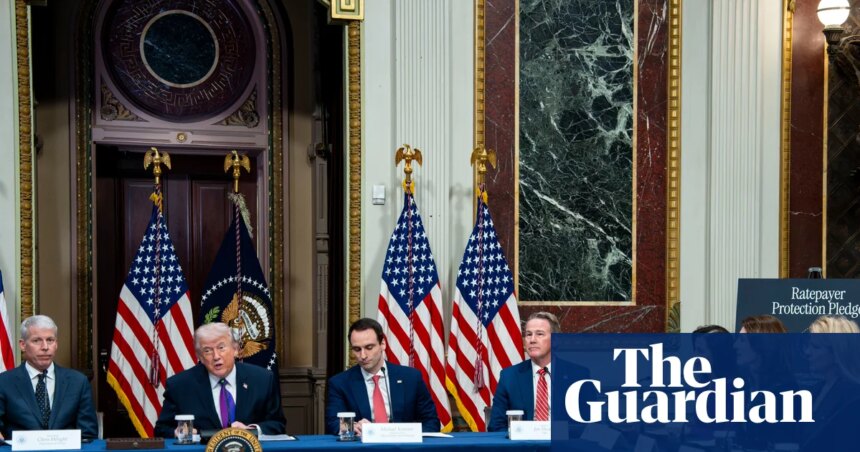
In a significant move towards energy accountability, major technology firms, including Google, Microsoft, Meta, and Amazon, have signed a pledge at the White House to take responsibility for the cost of new electricity generation required for their datacenters. This agreement aims to alleviate concerns regarding the rising electricity costs for U.S. households and small businesses, particularly in light of the Trump administration’s focus on curbing inflation.
During the pledge signing event, the president emphasized the importance of this initiative, stating, “This means that … the datacenters will be able to get the electricity they need, all without driving up electricity costs for consumers.” He hailed the agreement as a groundbreaking victory that would benefit American families and enhance the resilience of the national electricity grid.
Dubbed the “Ratepayer Protection Pledge,” this initiative was introduced by Trump in his recent State of the Union address. It comes at a time when local communities and state legislators are increasingly scrutinizing the rapid expansion of datacenters, which are known for their extensive electricity consumption needed to power server racks and cooling systems, particularly for the development of advanced technologies like artificial intelligence.
The pledge includes commitments from technology companies to secure and invest in electricity supplies for their datacenters. This may involve sourcing energy from new power plants or increasing output from existing facilities. Furthermore, the agreement mandates tech companies to assist in upgrading power delivery systems and to engage in special electricity rate agreements with utility providers. Such steps are intended to gain widespread support from localities that might typically oppose new datacenter developments.
This move has garnered attention for potentially reversing a trend where communities turned down datacenter projects due to concerns over energy consumption. “Some datacenters were rejected by communities for that, and now I think it’s going to be just the opposite,” Trump commented, referring to recent cancellations or delays of projects in various states linked to local opposition.
Companies like Oracle, xAI, and OpenAI were also present for the signing, reflecting a broad coalition of tech giants focused on enhancing their electricity capabilities amid increasing demand. With the November midterm elections approaching, the initiative addresses mounting voter concerns regarding energy affordability and the strain placed on the nation’s power grids by the proliferation of datacenters.
Trump has urged these companies to create or secure dedicated power capacity to meet their energy needs rather than relying solely on regional grids. This approach strives to balance the issues of technological competitiveness with the political and economic factors surrounding energy costs.
However, experts suggest there may be challenges ahead in swiftly delivering new power supplies to alleviate grid pressure. According to Jon Gordon, a senior director at Advanced Energy United, a clean energy trade group that includes datacenters, there may be complications in rapidly scaling energy generation to match increasing demand. He highlighted concerns that focusing on natural gas and fossil fuel sources might delay the integration of quicker-build renewable options like solar and wind.
The pledge is positioned as a test case for accountability in energy consumption by major corporations, with advocates and critics alike watching to see if it yields tangible results or remains largely symbolic. Lawmakers and consumer advocacy groups have called for enhanced protections to ensure that utility bills do not surge as a result of datacenter expansions. The outcome of this initiative could set a vital precedent in the ongoing discussion surrounding energy management in the tech industry.