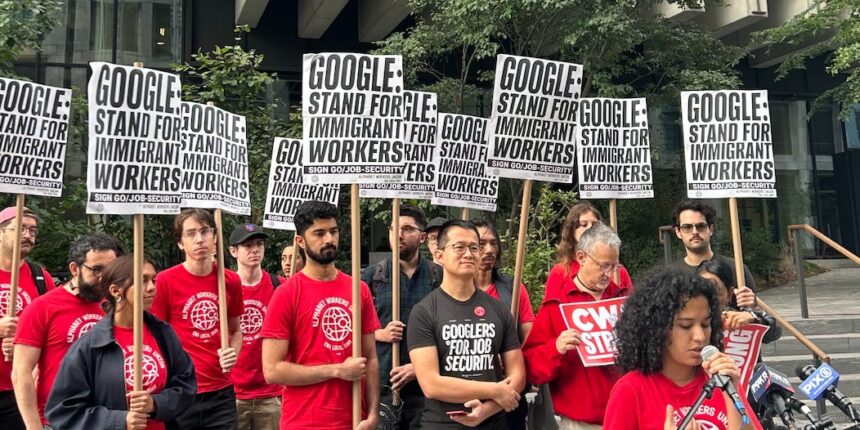
A gathering of approximately 25 tech workers convened in front of Google’s Lower Manhattan office on Monday morning to urge their employer to address recent developments affecting H-1B visa holders. This event was organized by the Alphabet Workers Union in reaction to an executive order issued by former President Donald Trump, mandating that businesses pay a $100,000 fee for employees on H-1B visas. The demonstrators, dressed in red union T-shirts and gray “Googlers for job security” apparel, expressed frustration with Google’s silence amid the upheaval this announcement has caused within corporate America.
Parul Koul, president of the Alphabet Workers Union, emphasized that while their primary target is the Trump administration, a public statement from a company of Google’s stature is crucial. “Google is one of the most powerful companies in the world, and they have yet to say anything about what’s happened and really take a stand and side with their own workers,” she remarked.
Following the executive order, many major tech companies swiftly communicated internally. For example, Google’s immigration legal advisor advised H-1B visa holders to either remain in the U.S. or return immediately if traveling, with clarifications later stating that the fee will only impact new applicants. However, as of Monday afternoon, Google had not issued any public response to the fee, and representatives did not comment when approached by Business Insider.
In 2024, Google had applied for nearly 5,500 H-1B visas, highlighting the company’s significant reliance on international talent. Tim Traversy, a software engineer and one of the speakers at the rally, questioned the company’s stance: “They are one of the largest and most powerful companies in the US. Will they stand with the immigrant workers that helped build this company?”
Lu Liu, a former H-1B visa holder from China, added his perspective on the situation, mentioning that he would have changed his travel plans had he still been under that visa. Liu also echoed the sentiment for Google to offer severance packages as an extended period on payroll, allowing more time for visa-holding workers to secure new employment in the event of layoffs.
The atmosphere outside Google’s office included moments of solidarity, as Google security personnel interacted amicably with union members, effectively quelling concerns of confrontation. Yet, as the workers prepared to enter the office for the first day back after the executive order, they were uncertain regarding the internal morale. Traversy noted that while discussions about such issues typically occur in private among colleagues, the underlying tension regarding immigration policy remains very present.
The broader context reveals a significant shift in how tech executives, including Google CEO Sundar Pichai, have engaged with political leadership. In recent months, many have courted the Trump administration, contributing millions to the inaugural fund and attending events at the White House. This shift contrasts with the more outspoken stance tech companies took on social issues just a few years ago, reflecting a cautious approach to controversial topics like immigration today. As employees anticipate the response within Google, the union’s call for action illustrates a growing urgency among workers to advocate for their rights in the face of changing political landscapes.