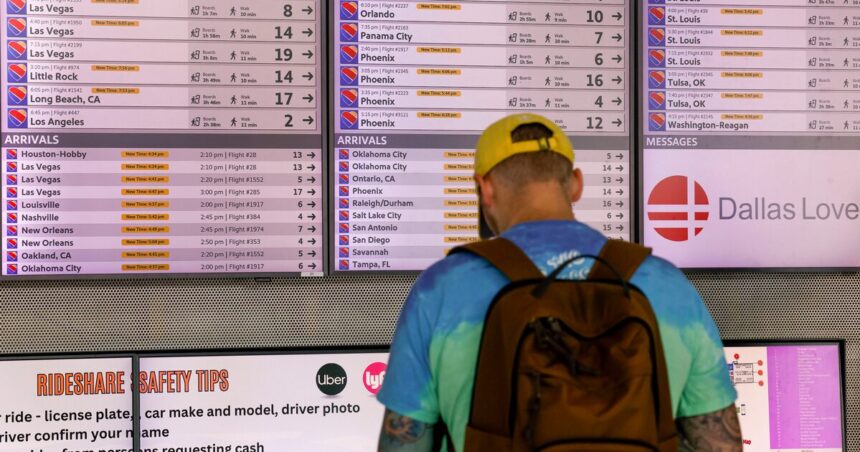
A significant disruption at Dallas/Fort Worth International Airport (DFW) and Love Field Airport on Friday evening was linked to multiple technological failures associated with a local internet service provider. The Federal Aviation Administration (FAA) reported that the outage stemmed from issues with the TDMI data telecommunications service provided by Frontier Communications, a Dallas-based company. This malfunction directly impacted the FAA’s Dallas TRACON facility, which is critical for managing air traffic as aircraft approach and depart from major airports.
Dallas TRACON facilities oversee air traffic within a 30 to 50-mile radius and up to altitudes of 10,000 feet. The FAA stated that operations have since returned to normal levels, and they are collaborating with airlines to establish recovery plans for flights that were affected by the disruptions.
The fallout from the outage was particularly pronounced for American Airlines and Southwest Airlines, both of which rely heavily on these airports. Fort Worth-based American Airlines operates out of DFW, whereas Dallas-based Southwest Airlines is primarily based at Love Field. Between 3 p.m. and 6 p.m. on Friday, only nine American flights managed to depart from DFW, a stark contrast to the normal rate of approximately 100 flights per hour. In total, more than 530 American flights were canceled on Friday, with an additional 160 cancellations reported on Saturday. By Saturday afternoon, DFW had recorded 251 delays and 155 cancellations, while Love Field experienced 46 delays but no cancellations.
David Seymour, the chief operating officer for American Airlines, reassured staff that at no point during the outages was the safety of the aircraft, crew, or customers compromised. He acknowledged the FAA’s rapid response in maintaining positive operational control despite the significant disruption.
FAA officials indicated that the incident highlighted critical issues with the agency’s infrastructure, noting that a contractor, L3Harris, had failed to ensure that the necessary system redundancies were operational. This failure underscores the urgent need for modernization of the air traffic control system, described as outdated and in need of critical upgrades to replace aging technology with more resilient digital solutions.
Friday’s incident mirrors past outages earlier this year, including multiple disruptions affecting air traffic control systems in New Jersey and a significant 90-second technology failure at a Philadelphia control facility.
In response to the ongoing issues, U.S. Transportation Secretary Sean Duffy reaffirmed the federal plans to overhaul the nation’s air traffic control infrastructure, emphasizing that the goal is to prevent disruptions like those experienced in Dallas from occurring in the future. He reiterated the administration’s commitment to establishing a new air traffic control system designed to meet modern travel demands.