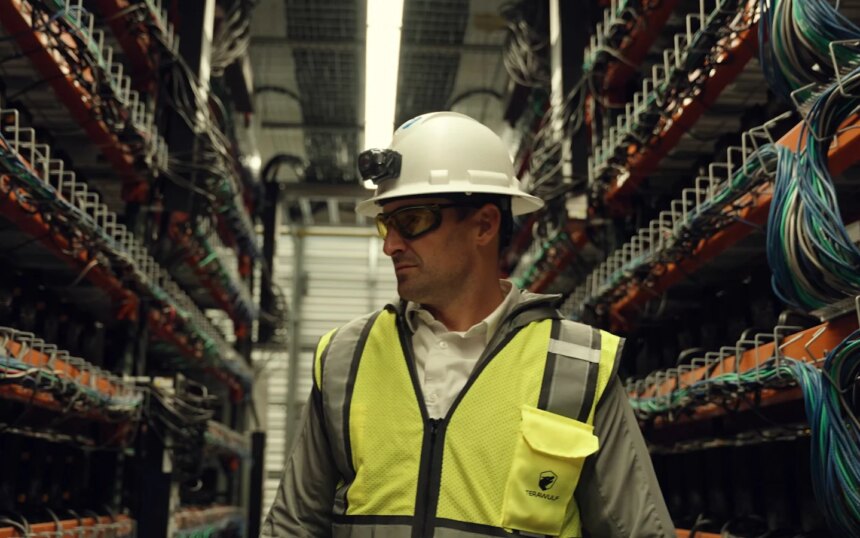
TeraWulf has reported a notable increase in its third-quarter earnings, reflecting substantial growth in its revenue streams. The company announced a year-over-year revenue increase of 87%, totaling $50.6 million for the quarter. This surge was predominantly driven by higher bitcoin production, an expanded mining capacity, and the introduction of revenue from its new AI business line.
Breaking down the figures, TeraWulf earned $43.38 million from bitcoin mining and an additional $7.2 million from its AI infrastructure services. However, the cost of revenue, excluding depreciation, saw a rise of 17%, reaching $17.1 million. TeraWulf’s financial positioning remains robust, with cash, cash equivalents, and restricted cash totaling $712.8 million at the end of the quarter.
During this period, TeraWulf successfully secured over $5 billion in long-term financing. This included vital funding for its Lake Mariner campus and equity contributions for the Abernathy joint venture in partnership with Fluidstack and Google. The company’s total outstanding debt stands at approximately $1.5 billion, primarily comprising convertible notes due in 2030 and 2031.
At the Lake Mariner facility located in Barker, New York, TeraWulf operates 245 megawatts (MW) dedicated to bitcoin mining and a further 22.5 MW for high-performance computing (HPC). Through its subsidiaries, La Lupa Data LLC and Akela Data LLC, the company manages over 520 MW of long-term HPC leases. Notably, La Lupa’s Core42 leases are projected to generate $1.1 billion in contracted revenue from 72.5 MW of GPU-optimized capacity.
In a significant move during the quarter, TeraWulf executed three 10-year Fluidstack leases for the Lake Mariner campus, amounting to approximately $6.7 billion in contracted lease payments, supported by a $3.2 billion credit enhancement from Google. Additionally, the Abernathy joint venture in Texas aims to develop 240 MW of HPC capacity, with plans for potential expansion up to 600 MW under a 25-year lease, backed by $1.3 billion of Google credit.
The company also signed an 80-year lease for a future HPC campus in Lansing, New York, projected to commence operations in 2027, and acquired a 51% stake in a proposed 200 MW Fluidstack-led project.
In comments on the company’s trajectory, Chief Executive Officer Paul Prager stated that TeraWulf is looking to expand its partnerships with Fluidstack and Google while laying the groundwork for growth through 2027. Chief Operating Officer Sean Farrell noted that construction at the Lake Mariner and Akela sites is progressing towards key delivery milestones.
Addressing future developments in the AI data center space, Prager hinted during the Q3 earnings call at the potential announcement of one or two new sites by the end of the year.
Chief Financial Officer Patrick Fleury emphasized that the successful capital formation of $5 billion establishes a strong foundation for scaling TeraWulf’s operational platform. The company remains committed to its objective of adding between 250 to 500 MW of new HPC lease signings each year, in response to an expanding customer base and increasing demand for low-cost, low-carbon computing solutions.
At the time of publication, TeraWulf’s stock had experienced a 2.6% increase.