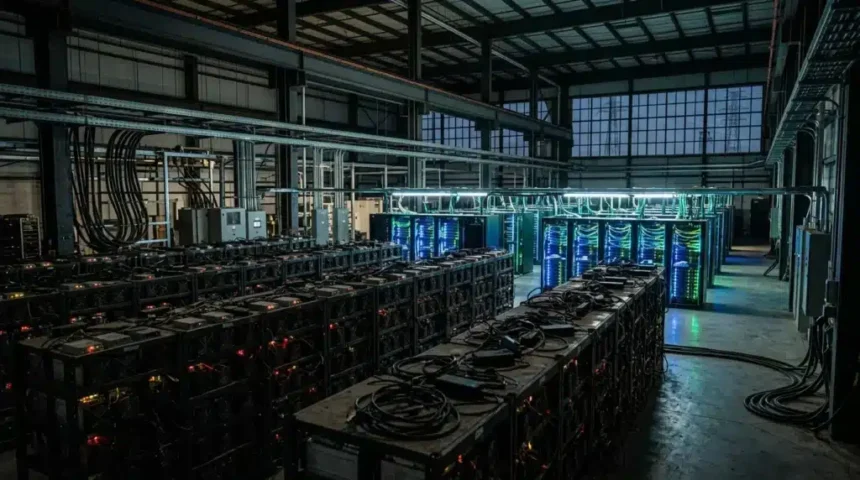
In a groundbreaking move that signals a major shift in the cryptocurrency landscape, the Maryland-based Bitcoin mining company TeraWulf has announced the acquisition of the Muskie Data Campus, a sprawling 285-acre site located within the EastPark Industrial Park in eastern Kentucky. This acquisition, revealed on Tuesday, is set to pave the way for TeraWulf to develop over 1 gigawatt of artificial intelligence (AI) data center capacity in the region, marking a significant pivot away from its traditional Bitcoin mining operations.
To put this development into perspective, 1 gigawatt of energy has the capability to power approximately 750,000 homes. This significant energy investment is now being focused primarily on AI rather than Bitcoin mining. Following the announcement, TeraWulf’s stock (WULF) experienced a notable uptick, surging by 9% to reach $25.92—its highest price in the past year.
The announcement highlights a crucial turning point for TeraWulf: its Bitcoin mining revenues plunged by 50% in the first quarter of 2026. In stark contrast, its AI compute revenue skyrocketed by 117% quarter-over-quarter, amounting to $21 million, and now represents 60% of the company’s total revenue. This is the first time that revenue generated from AI has surpassed that from Bitcoin mining, signaling a fundamental re-evaluation of the company’s strategic focus.
TeraWulf’s acquisition of the Muskie Data Campus is poised to significantly enhance its operational capacity, with expectations that 500 megawatts of AI data center capabilities will come online by late 2028, followed by an additional 500 megawatts by 2030. This ambitious plan aligns with Kentucky Power’s ongoing construction of a crucial 345-kV substation that will interlink with a larger 765-kV transmission network, underscoring the importance of robust energy infrastructure in attracting investment.
CEO Paul Prager underscored the ongoing constraints in market power and transmission infrastructure, which have prompted AI firms to seek out capacity from former Bitcoin miners willing to pivot. This shift adds a second major footprint in Kentucky to TeraWulf’s portfolio, complementing its existing 480-megawatt Justified Data campus located in Hancock County.
Moreover, TeraWulf’s new direction involves a significant contract worth $3.7 billion with AI cloud provider FluidStack. This agreement has the potential to escalate to $8.7 billion over a 20-year period, supported by a $1.3 billion lease commitment from Google at TeraWulf’s Texas AI campus. While the company reported a staggering net loss of $427 million in Q1 2026—up from $61.4 million in Q1 2025—this loss is attributed more to intense capital expenditures related to this transition than to operational failures.
This pivot raises questions about the future of Bitcoin mining, particularly given that key players in the sector, such as IREN, MARA Holdings, and Hive Digital Technologies, are also migrating toward AI and high-performance computing. Notably, the Bitcoin halving event in 2024 has halved block rewards from 6.25 BTC to 3.125 BTC, furthering the challenge for miners as operational costs remain stable. In contrast, AI hosting provides more stable and dependable revenue streams, making it an increasingly attractive alternative to the volatility associated with cryptocurrency mining profits.
As the crypto landscape evolves, companies like Core Scientific are also forming partnerships, such as their recent deal with CoreWeave regarding AI hosting capacity. While some firms, including MicroStrategy, continue to double down on Bitcoin accumulation, TeraWulf represents a departure from this trend by redefining its focus toward profitability via AI-driven endeavors.
In this context, control over energy infrastructure has emerged as a vital asset in both Bitcoin mining and AI operations, granting companies significant leverage. The convergence of blockchain technology and AI computing is still in its infancy, capturing the attention of investors seeking early-stage opportunities in this evolving marketplace. TeraWulf’s commitment to a 1-gigawatt investment in Kentucky reflects a growing recognition of the importance of energy resources.
Looking ahead, the future of Bitcoin mining will hinge on its ability to compete with the more reliable revenue generated from AI hosting. As companies like TeraWulf recalibrate their strategies amid changing economic realities, it remains to be seen whether traditional mining methodologies can withstand the allure of AI-driven solutions. Observers will be closely monitoring the upcoming completion of the Abernathy Texas AI campus and TeraWulf’s Q2 revenue results for more insight into this dynamic transition.