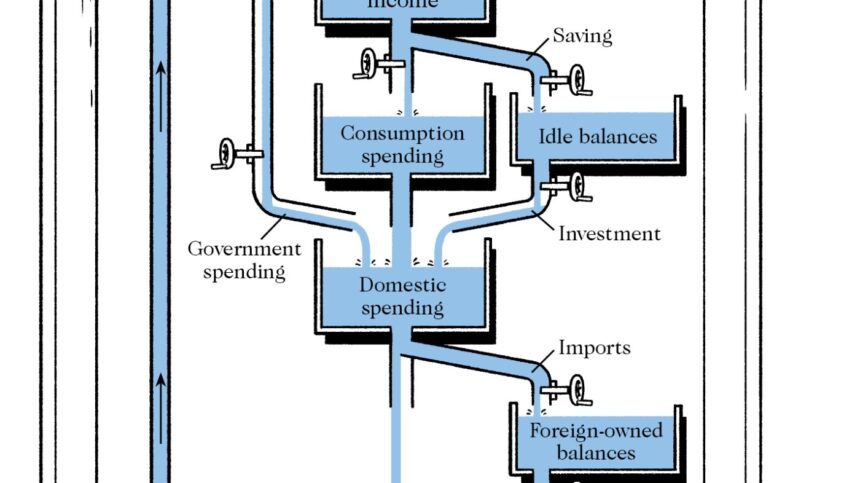
In a fascinating exploration of economic principles, the latest book from the Planet Money team sheds light on the innovative methodologies employed by economists like Bill Phillips. Phillips, renowned for formulating the “Phillips Curve,” took a unique, hands-on approach to economics that set him apart in his field.
Born in New Zealand, Phillips’s early career spanned various adventurous pursuits, ranging from crocodile hunting to gold mining, before settling into electrical engineering. Post-World War II, he turned his focus to economics, studying in London, where he crafted an imaginative model of the British economy in his garage. Using a series of tubs and chambers connected by flowing water, Phillips demonstrated how government spending and taxation influenced economic dynamics. This “Rube Goldberg” machine not only captivated attendees at the London School of Economics but also solidified his reputation as a forward-thinking economist.
Phillips’s creativity did not go unnoticed. His presentation prompted a shift in the dynamics of the school, leading to his employment and eventual collaboration with other economists. His work addressed the chaotic nature of market economies, which are often marked by cycles of booms and busts known as the business cycle. These oscillations between growth and contraction have historical precedence, with stock market crashes occurring at intervals and prompting instability.
John Maynard Keynes, a dominant figure in economic thought, proposed that government intervention could stabilize these fluctuations. He argued that by adjusting spending in response to economic conditions, governments could serve as counterweights to the unpredictability of market economies. Phillips and his contemporaries recognized the interplay of inflation and unemployment, which became a focal point for their research. They developed the concept of the wage-price spiral, illustrating how low unemployment could lead to increased wages and, consequently, inflation.
A pivotal moment came when a colleague presented Phillips with a comprehensive dataset of the UK’s wage and unemployment statistics. After analyzing the data, Phillips unveiled a groundbreaking graph that demonstrated an inverse relationship between unemployment and wage growth. This finding illustrated the trade-off between inflation and employment, establishing a clear connection between these two economic indicators. The graph quickly became known as the Phillips Curve and was later popularized in economic textbooks, influencing policymakers and central bankers in the United States and the UK.
Governments began to utilize the Phillips Curve as a guide for economic strategy, treating it almost like a manual to navigate the complexities of inflation management. Central banks such as the Bank of England and the Federal Reserve adopted the curve as part of their toolkit, despite their initial limited understanding of inflation dynamics at the time of its conception.
The transition to fiat currency in the mid-20th century marked a significant shift in economic theory and practice. While the Phillips Curve initially provided a framework for managing inflation, the unpredictable behaviors of the economy during the 1970s prompted economists to re-evaluate and adapt their approaches. As the story of Phillips and his curve unfolds, it reflects the evolution of economic thought and the persistent challenge of understanding and managing market forces.
This excerpt from the book captures the essence of economic exploration while offering a glimpse into the creative methodologies that have shaped our understanding of the market over time. Readers are encouraged to seek out “Planet Money: A Guide to the Economic Forces That Shape Your Life,” now available in bookstores, to delve deeper into these and other compelling economic narratives.