The Minnesota Timberwolves faced a formidable challenge recently, having to go up against the Golden State Warriors without their star player, Anthony Edwards, and with point guard Mike Conley also sidelined due to injury. The situation appeared dire, as the Timberwolves walked into a highly competitive environment at Chase Center, fully aware of the Warriors’ previous playoff struggles against them. However, what unfolded was an unexpected display of resilience and teamwork, leading to a significant victory for Minnesota.
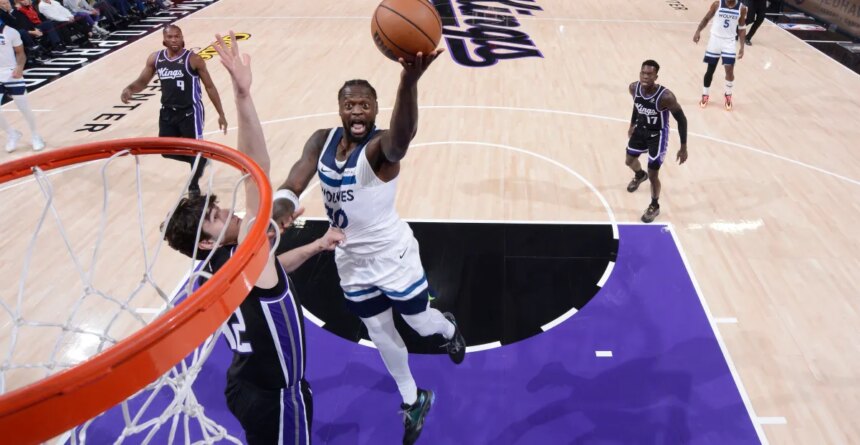
With Edwards absent, the Timberwolves’ objective shifted from seeking a comfortable win to merely avoiding a total collapse against a determined Warriors squad. Bones Hyland, stepping into a starting role, ignited the offense before he too succumbed to injury. This left Julius Randle with the responsibility to lead the team offensively, and he rose to the occasion magnificently. Randle scored 27 points, showcasing a diverse scoring ability that kept Minnesota competitive. He played with authority, effectively leveraging his size to dictate matchups and create high-percentage shots, embodying the essence of a primary option in the absence of the usual top scorer.
Rudy Gobert also emerged as a critical factor for the Timberwolves. With the Warriors missing key defenders like Draymond Green and Al Horford, Gobert capitalized on the size mismatch, delivering a series of powerful finishes and dominating the boards. His defensive presence not only deterred Golden State’s penetration but also added pressure around the rim, proving essential for Minnesota’s success.
The game was not without its tense moments, particularly in the fourth quarter when Warriors superstar Stephen Curry began to heat up. Yet, Timberwolves guard Donte DiVincenzo played a crucial role, responding with composure rather than panic. His timely shot-making helped secure the lead and ultimately allowed Minnesota to escape with a 106-99 victory, marking a standout win of their season.
As the Timberwolves celebrated their significant triumph, they prepared for a critical matchup against the Sacramento Kings, a team that had previously taken advantage of Minnesota’s downturn this season. The upcoming game posed a test of character and execution. The Timberwolves understood the importance of not just relying on individual talent but rather coming together as a cohesive unit. With both Edwards and Conley still uncertain to play, maintaining the momentum from the previous game became imperative.
Key areas of focus for the Timberwolves included playing disciplined and smart basketball to avoid falling back onto survival tactics. Emphasizing team play would be crucial, especially as Sacramento was set to be without their own key player, Domantas Sabonis.
Moreover, Minnesota needed to leverage their size advantage effectively. Past encounters revealed shortcomings in capitalizing on physical matchups, and the Timberwolves aimed to impose their will in the paint to dictate the game’s pace and rhythm. Gobert, alongside Randle and Naz Reid, had to crash the boards aggressively to wear down the Kings and prevent second-chance opportunities.
The contributions from the team’s younger players were highlighted as essential for Minnesota’s continued success. Players such as Rob Dillingham, Terrence Shannon Jr., and Jaylen Clark needed to mature into reliable assets on the court, not only in scoring but also in maintaining defensive intensity and composure under pressure.
Lastly, the Timberwolves faced the challenge of maintaining their newfound momentum. The victory over the Warriors had sparked hope and renewed enthusiasm, but they understood that this upcoming game against Sacramento required equally focused and mature play to prove that their resilience wasn’t merely a one-time occurrence.
With the stakes heightened in a tightly contested Western Conference, the Timberwolves knew that protecting their momentum would be crucial. They aimed to build upon their last victory, showcasing progress and laying the groundwork for a promising season ahead. As they entered this pivotal matchup, the call to action was clear: impose their will, play cohesively, and transform transient success into a sustainable, winning culture.