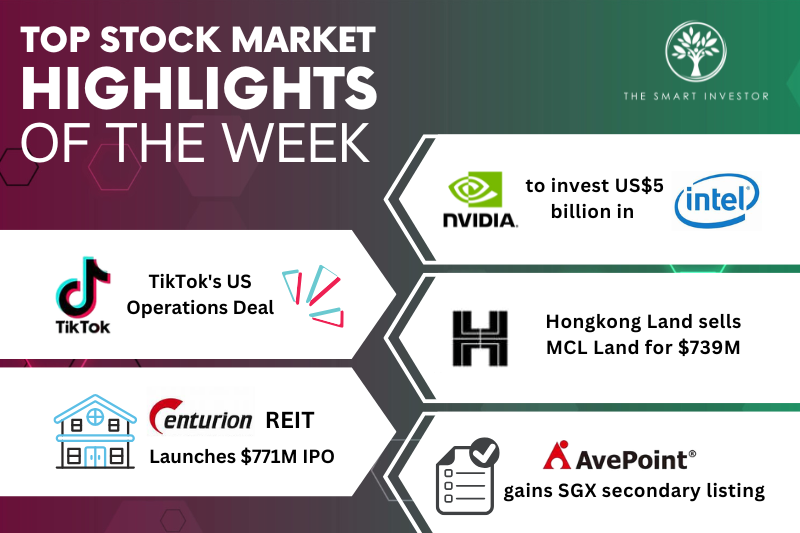
This week has been pivotal for several sectors in the stock market, with Intel experiencing its most significant trading day in nearly four decades and advancements in negotiations regarding TikTok’s operations in the United States and China.
Intel shares surged by 22.8%, reaching US$30.57 on September 18, marking the company’s best trading day since October 1987. This spike followed Nvidia’s announcement of a strategic investment amounting to US$5 billion in Intel, aimed at co-developing data center and PC chips. Nvidia’s stake is set at US$23.28 per share, showcasing a strong partnership designed to enhance Intel’s recovery efforts. Notably, Intel joins an esteemed group of investors, including Softbank and the U.S. government, which had previously taken a 10% stake valued at US$8.9 billion. This investment is now worth around US$13.2 billion after the share price surge. The agreement stipulates that Intel will manufacture x86 CPUs for Nvidia’s AI platforms, as well as develop advanced system-on-chips that incorporate Nvidia’s RTX graphics technology. The collaboration has garnered praise from the White House, with spokesperson Kush Desai emphasizing its significance for American high-tech manufacturing.
In parallel, progress on the ongoing negotiations concerning TikTok’s future in the U.S. has emerged, as representatives from Washington and Beijing reached a preliminary framework for a potential deal. This agreement would establish an American entity to operate TikTok in the U.S., with 80% ownership held by American investors and 20% retained by Chinese shareholders. The consortium includes tech giants like Oracle, which saw its stock dip by 1.59% following the news, alongside private equity firms such as Silver Lake and venture capital firm Andreessen Horowitz. The new entity is expected to facilitate a transition for current U.S. users to a new app that TikTok is developing. Oracle is positioned to manage user data, while TikTok’s engineers will rework content-recommendation algorithms using technologies licensed from ByteDance. The arrangement will include an American-dominated board, with one member appointed by the U.S. government. President Trump has indicated plans to discuss the framework with Chinese President Xi Jinping, while a 16 December deadline for extending the TikTok ban allows time for the deal to take shape.
In Singapore, the IPO market showcased robust activity, highlighted by Centurion Accommodation REIT’s S$771 million listing and AvePoint’s secondary introduction. Hongkong Land announced a strategic transformation through the S$739 million divestment of MCL Land to Malaysia’s Sunway Group. This divestment aligns with Hongkong Land’s strategic focus on ultra-premium integrated commercial properties. The sale includes MCL Land’s residential operations in Singapore and Malaysia, contributing to the group’s capital recycling strategy, which has reached US$2 billion since 2024.
Centurion Accommodation REIT is set to make its debut on the Singapore Exchange on September 25, with a target of S$771 million. This REIT will consist of 15 assets worth S$2.2 billion, including worker accommodations in Singapore and student housing in the UK and Australia. The CEO noted that the demand for foreign worker accommodations in Singapore significantly outpaces supply, further underscoring the need for such investments.
AvePoint, a company specializing in data management and governance solutions, achieved a milestone with its secondary listing on the Singapore Exchange, allowing local investors to access its growth story without the company needing to raise new capital. The firm’s revenue shows a consistent upward trend, with a projected revenue increase that highlights its vitality in the SaaS sector. This move not only diversifies AvePoint’s investor base but also strengthens Singapore’s status as an emerging technology hub.
Investors will be keen to see how these developments will play out in the markets moving forward, with significant opportunities on the horizon in both the technology and real estate sectors.