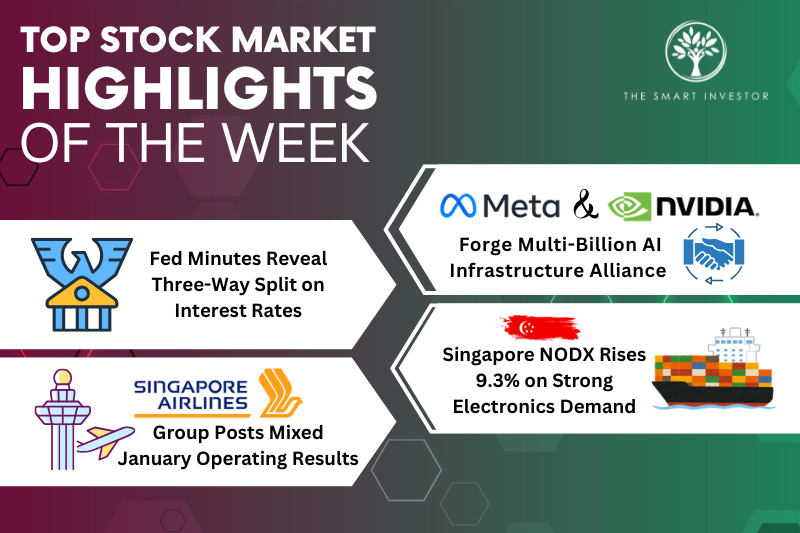
This week marked significant developments across various sectors, spanning technological advancements, monetary policy shifts, and economic performance indicators from Singapore.
In a noteworthy partnership, Meta Platforms and Nvidia announced a multiyear agreement to construct hyperscale AI data centers. This collaboration is projected to be valued in the tens of billions, further fueling the current surge in AI infrastructure investment. The deal encompasses millions of Nvidia’s existing Blackwell GPUs and the forthcoming Rubin GPUs, alongside crucial Spectrum-X Ethernet networking equipment. A highlight is Meta’s pioneering deployment of Nvidia’s Grace CPUs as stand-alone chips in large-scale production, aimed at enhancing efficiency in AI workloads. With a commitment of up to $135 billion dedicated to AI infrastructure for its Meta Superintelligence Labs by 2026, Meta is clearly doubling down on its AI ambitions. Nvidia’s CEO emphasized the collaborative design process integrating both hardware and software, reinforcing Nvidia’s competitive position. In light of this partnership, Meta and Nvidia’s stock prices rose, while shares of rival Advanced Micro Devices dipped 4%, as investors perceived this alliance as a potential barrier to competition.
In monetary policy news, the minutes from the US Federal Reserve’s recent meeting revealed a more divided stance among officials than the market had anticipated. While the benchmark interest rate remained unchanged in the range of 3.5% to 3.75%, officials are now split into three distinct groups. One faction advocates for rate cuts should inflation decrease, another opts for maintaining the current rates, and a third, more hawkish group cautions that rate hikes are still a possibility if inflation stays above the 2% target. The Fed’s preferred PCE inflation measure sits roughly 1% above this benchmark. Notably, two governors expressed dissent in favor of an immediate rate cut, citing concerns over labor market dynamics. As uncertainty looms, Kevin Warsh, nominated by Trump, has voiced support for reducing rates, though market expectations for a rate cut do not foresee action until at least June.
In Singapore, non-oil domestic exports (NODX) experienced year-on-year growth of 9.3% in January 2026. However, this figure fell short of the 12.1% growth anticipated by analysts. The positive performance was primarily driven by a remarkable 56.1% surge in electronics, largely influenced by AI-related demand and a favorable comparison to the previous year. Integrated circuits accounted for the majority of this growth, increasing by 80.5%, with disk media following closely at 70.2%. Conversely, non-electronics exports saw a decline of 3%, hindered by weakness in specialized machinery and petrochemicals. On a geographical level, export demand varied significantly, with double-digit growth in shipments to China, Hong Kong, and the EU, while exports to the US and Indonesia fell. Despite the shortfall in January, EnterpriseSG has revised its full-year NODX forecast upward to a growth range of 2% to 4%, reflecting overall trade momentum and a robust GDP growth of 6.9% in Q4 2025.
In the airline sector, Singapore Airlines reported mixed results for the year. On the airline’s main operational level, the number of passengers carried dipped slightly by 0.3% to 2.35 million, accompanied by a reduction in the passenger load factor to 86.1%. However, looking at the broader SIA Group, which includes budget carrier Scoot, passenger numbers climbed 4.1% to a total of 3.66 million, even as the overall load factor saw a slight decrease to 86.6%, attributed to capacity growth outpacing traffic volumes. Cargo volumes demonstrated modest growth as well, rising 1.2% with an improved cargo load factor of 52.1%. Following the announcement, SIA shares saw a minor increase of 0.57% to S$7. Looking ahead, the airline has expressed optimism regarding travel demand, planning to enhance capacity for the Northern Summer season of 2026, including increased flight frequencies to Bangkok and other Southeast Asian destinations.
Overall, the week’s developments underscore a complex interplay of advancements in technology and finance, reflecting both opportunities and challenges on the horizon for businesses and policymakers alike.