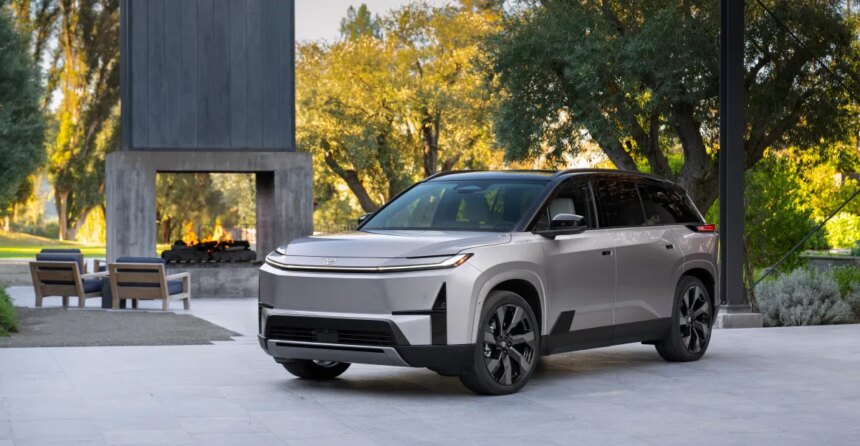
Toyota has officially unveiled the 2027 Highlander, a fully redesigned midsize SUV that sets a new benchmark for the brand as its first three-row electric vehicle for the U.S. market. This marks a significant milestone, as it is also the first Toyota EV to be assembled in America, aimed squarely at one of the most popular vehicle segments in the country.
The new Highlander retains the familiar name, having been part of Toyota’s lineup for over two decades, but brings an entirely new powertrain that positions it to compete aggressively with other electric vehicle offerings. This launch comes at a critical juncture for Toyota, which has been navigating a shifting landscape in the automotive market. While global EV sales have shown signs of slowing, Toyota’s focus on hybrid vehicles appears to be validated, especially as competitors report substantial losses due to their EV investments.
The vehicle arrives under the leadership of new CEO Kenta Kon, who is closely associated with former chairman Akio Toyoda. His appointment signifies an acknowledgment of Toyota’s resilience in the face of challenges such as Chinese electric vehicle competition, global tariffs, and the costly transition to electric mobility. The Highlander, produced at Toyota’s Kentucky facility, is a strategic move to mitigate potential tariffs and leverage domestic manufacturing.
This electric SUV will be offered in two trims: XLE and Limited, with the XLE available in both front-wheel drive and all-wheel drive configurations. The Limited trim will come standard with all-wheel drive. Battery options include a 77kWh pack and an expansive 95.8kWh pack, with the AWD versions featuring the larger battery boasting an impressive estimated range of up to 320 miles, along with 338 horsepower and 323 lb-ft of torque. Front-wheel drive models will provide 221 horsepower and 198 lb-ft of torque.
The Highlander also boasts a comprehensive infotainment upgrade, mirroring features found in Toyota’s new C-HR and bZ Woodland electric SUVs. Highlights include a 14-inch central touchscreen, a 12.3-inch digital gauge cluster, customizable ambient lighting, and seamless wireless connectivity for Apple CarPlay and Android Auto. Additionally, the vehicle supports extensive charging options for devices positioned throughout all three rows, complemented by a fixed panoramic glass roof that is the largest ever offered by Toyota.
The vehicle’s new infotainment system integrates AT&T 5G connectivity, providing a customizable home screen, enhanced voice recognition via “Hey Toyota” commands, and dual Bluetooth phone connectivity. Users can also access streaming services such as Spotify and SiriusXM integrated directly into the system.
Accommodating seven passengers comfortably with a third row that folds flat for additional cargo space, the Highlander delivers over 45 cubic feet of rear storage when needed. It comes equipped with numerous features, including wireless charging trays, multiple USB-C ports, rear HVAC controls, optional rear window shades, and a hands-free power liftgate.
For charging, the Highlander will include a North American Charging Standard (NACS) port, allowing access to Tesla Superchargers. Under optimal conditions, its battery can rapidly recharge from 10% to 80% in about 30 minutes using DC fast charging technology. Features like battery preconditioning, which prepares the battery for optimal charging, will also be available as part of a Drive Connect subscription.
The Highlander will introduce vehicle-to-load capabilities, enabling it to serve as a mobile power bank. According to Toyota, the SUV can even provide backup power during a blackout when equipped with specific bidirectional accessories, with further announcements regarding this feature expected in the future.
With dimensions of 198.8 inches in length, 78.3 inches in width, and 67.3 inches in height, alongside a wheelbase of 120.1 inches, the new Highlander will compete directly with other three-row electric SUVs currently on the market, such as the Rivian R1S and Kia EV9.
Toyota plans to disclose pricing details later this year as the Highlander moves into production. The automaker appears to be revitalizing its efforts in the electric vehicle segment, especially following the success of the recently revamped bZ (formerly bZ4x), which ranked fourth in overall EV sales in the U.S. in January, outperforming competitors like the Hyundai Ioniq 5 and Ford Mustang Mach-E. With additional electric models such as the C-HR hatchback and bZ Woodland slated for launch later this year, Toyota has a unique opportunity to enhance its position in the rapidly evolving EV landscape.